Rivier FNP simulation check-offs: attempts, the 84% bar and re-entry
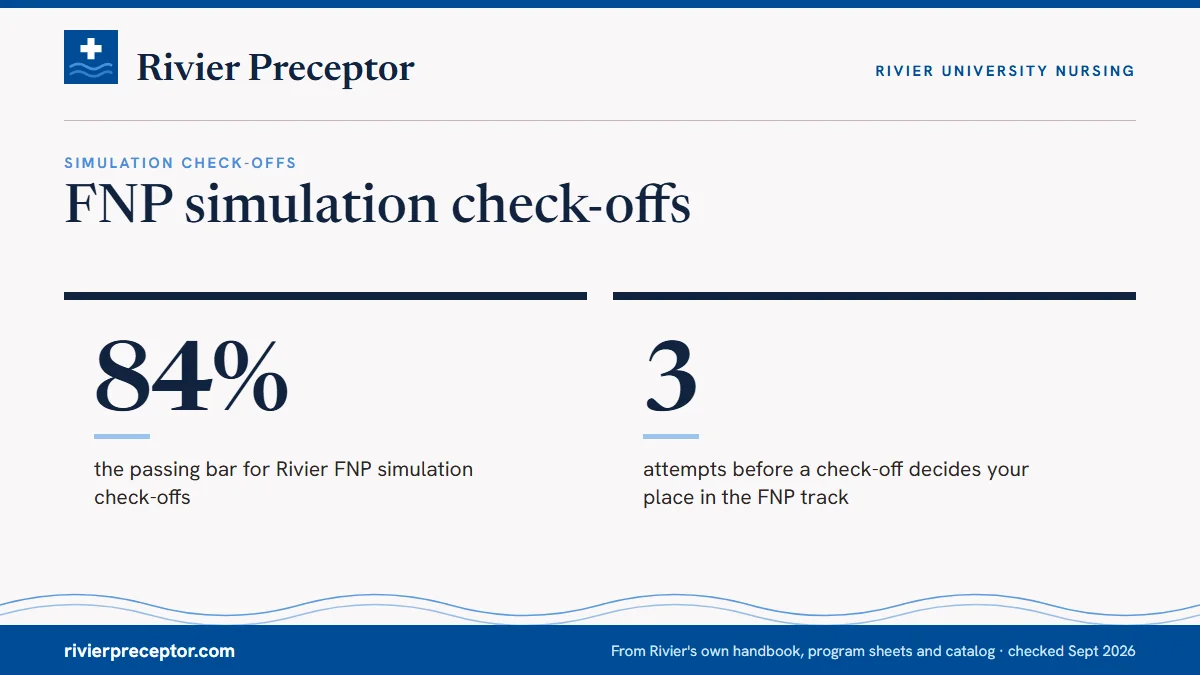
Rivier University's Nursing Student Handbook sets a simulation check-off in each FNP practicum, passed at 84% or higher. A third failed attempt in NSG511 or NSG513 ends your place in the FNP track, while in NSG515 a third attempt leads to a remediation plan. The same Simulation Lab hosts the re-entry assessments and competency tests that bring students back after a leave or a dismissal.
Get your placement plan
Tell us your Rivier program and where you live. A placement advisor replies with the preceptor and site options that fit your Rivier course.
The check-off rule in each FNP practicum
The Handbook's progression section sets the same passing mark in all three FNP practicums and a different consequence in the last one.
| Course | Passing score | After a third failed attempt |
|---|---|---|
NSG511 (NURS 511) | 84% or higher | Dismissal from the FNP track |
NSG513 (NURS 513) | 84% or higher | Dismissal from the FNP track |
NSG515 (NURS 515) | 84% or higher | A remediation plan; failing the plan means dismissal from the track |
The Handbook uses NSG and NURS for the same courses, so NSG511 and NURS 511 are one course. It does not break down the skills each check-off tests or when in the semester it falls, so ask your course faculty for both at the start of each practicum. The NURS 511 guide covers the first course in the sequence.
What 84% means in Rivier nursing
The nursing Handbook treats 84% as a B and uses a BC grade between B and C. The university grading scale in the 2025-26 catalog is different: it puts B at 83 to 86 and has no BC. The catalog points nursing students to its Nursing section for their rules, so for check-offs and practicum grades the Handbook's 84% is the mark to aim above.
The same number runs through the graduate rules. Ending a practicum course under 84% costs you your place in the graduate track, a theory course repeated after a BC or C must reach 84%, and the competency sheet used for readmission must score 84% or higher. If your average in any nursing course slips below B during the semester, expect a Written Notice in your Rivier email from the instructor, laying out a plan to improve. The grades and progression guide covers probation and repeats.
Where check-offs happen
The Handbook lists FNP simulation check-offs among the graduate uses of Rivier's Simulation Lab, along with re-entry assessments and readmission competency tests. Rivier's Nursing Simulation and Clinical Education Center occupies the second floor of Sylvia Trottier Hall in Nashua, with six simulation labs and assessment areas; Rivier's 2022 announcement of the renovated center describes examination rooms, telehealth offices and labs set aside for nurse practitioner training.
Course materials may use either of two names, since the Handbook also refers to the space as the Nursing Simulation and Clinical Learning Center. FNP students also come to campus for three intensives, nine days in total, and the 2026-27 calendar schedules the fall intensive from August 24 through September 4, 2026 and the spring one from January 4 through 15, 2027. Whether a particular check-off falls during an intensive is a question for your course faculty; the campus intensives guide puts those dates in context.
Check-offs after repeating NSG510 or NSG512
A grade below B in either FNP theory course, NSG510 or NSG512, means repeating it before you progress to the next practicum. The Handbook gives you a choice for the repeat semester, and one of the two paths ends in a check-off.
- Stay clinical. Repeat the theory course while completing 80 clinical hours to keep your skills current. Those 80 hours maintain proficiency but count toward no future practicum total.
- Step back from clinical. Repeat the theory course with no clinical hours, then sit a skills check-off (the Handbook calls it a competency retest) right as you re-enter the practicum sequence.
Either way, your next practicum starts a semester or more later than planned, which means a preceptor, a contract and a deadline for the new start date. Rebuilding that placement plan early keeps the delay to the repeat itself.
Returning from a leave or applying for readmission
Students in good standing can request a leave of absence in writing from the Director of Graduate Nursing Education, and total leave across your whole program cannot exceed one calendar year. Give at least three weeks' notice before the semester you plan to return, since seats in nursing courses for returning students are space-available. FNP students coming back from leave are also assessed in the Simulation Lab on their return. The Handbook's leave rules disagree on how long an absence can run before you must reapply (one year in one place, three in another), so confirm your own limit with the Program Director.
Readmission after a dismissal begins in writing: you apply to the Graduate Nursing Admissions Committee, whose meetings fall at each semester's close, and the Division Dean decides within two business days. If you withdrew from a practicum, readmission also calls for a clinical competency sheet with a score of at least 84%, and that sheet expires after 30 days. Being dismissed from the MSN program a second time closes the door to readmission. The leave, withdrawal and readmission guide has the full policy.
How steady clinical time supports your check-offs
Regular patient contact is the most direct practice you get between check-offs. A placement that keeps you seeing patients at the Handbook's suggested pace, 4 to 6 per 8 hours in Practicum I rising to 8 to 10 in Practicum III, gives you steady hands-on time every week. A preceptor who cancels often, or a site running well under that volume, leaves you with less.
That is why Rivier FNP students choose us for placements. We line up Rivier-qualified preceptors whose clinics run at the volume your course expects, confirm their availability across the whole semester, and replace a preceptor quickly if one steps away, so your clinical time keeps building between check-offs. How it works walks through our process, and the form below starts it.
Questions to settle with your course faculty
- Which skills and scenarios each check-off assesses, and whether a practice attempt is offered.
- When each check-off falls in the semester, and whether it happens during an FNP intensive.
- How soon a second or third attempt can be scheduled after a miss.
- What the NSG515 remediation plan includes and how long it runs.
- Whether a New Hampshire RN license is still needed for on-campus FNP activities, as an older 2018 Rivier form stated, or whether a multistate license covers you.
- Whether your re-entry assessment after a leave or theory repeat uses the same format as a course check-off.
- Whether a check-off result is folded into your course grade or recorded separately as a pass or fail.
Questions Rivier students ask
How many attempts do Rivier FNP students get at a simulation check-off?
Three. In NSG511 and NSG513, failing the third attempt to reach 84% means dismissal from the FNP track. In NSG515, a third attempt leads to a remediation plan instead, and dismissal follows only if you do not pass that plan. Ask your course faculty how the attempts are scheduled within the semester.
Is 83% a pass on a Rivier FNP check-off?
Not under the nursing rules. Rivier's university-wide scale counts 83 as a B, but the nursing Handbook sets 84% as its B and as the passing mark for FNP check-offs, and the catalog directs nursing students to the Nursing section. If a score lands at 83, speak with your course faculty right away.
Do I need a check-off to come back from a leave of absence?
Yes, in the form of a re-entry assessment, held in the Simulation Lab, for every FNP student returning from leave. Give Rivier three weeks' notice or more ahead of the semester you want to rejoin, since a returning student's seat depends on space, and ask your course faculty what the assessment covers so you can prepare for it.
What is the clinical competency sheet in Rivier's readmission policy?
It is the scored competency check a student needs when seeking readmission after withdrawing from a practicum. The score must be 84% or higher, and it lapses 30 days after it is scored, which is why it should be completed near your return date. Readmission requests go to the Graduate Nursing Admissions Committee, which reviews them as each semester ends.
Can I appeal a practicum grade at Rivier?
Yes, through the Handbook's grade grievance process. You start by writing to your instructor. If that does not settle it, you have 10 calendar days to take it to the MS Nursing Faculty Committee, signing consent so its members can see your coursework, and the Dean hears the last stage. Ask whether a check-off result falls under it.
Related pages
Last checked 2026-09-26
We check these pages against Rivier's own Nursing Student Handbook, program sheets, catalog, academic calendar and State Guide. Your program of study, your course faculty, your Program Director and the Clinical Practicum Coordinator have the final word.
Rivier asks you to identify a qualified preceptor. We make that the easy part.
Tell us your Rivier track, where you live and which semester your next practicum starts. We find preceptors who meet your track's rules, check early whether the site can contract with Rivier, and prepare everything the Preceptor Request Form asks for, well ahead of August 1 and December 1.
- Preceptors matched to the track: an MD, DO or FNP in outpatient family practice for
NURS 511, a psychiatrist or PMH-certified NP forNURS 521, a hospitalist or intensivist forNURS 638P - Preceptor license, credentials and CV ready for the Preceptor Request Form, with the site's contact details for the contract
- In your own area, in New Hampshire or any state Rivier's State Guide accepts
Start your placement plan
Track, city and semester is all we need to begin.