How a Rivier practicum placement comes together, start to finish
At Rivier University, graduate nursing students secure their own practicum placements, and the path from first search to first counted hour runs across most of a year. This page puts every step in order and points you to the guide for each one, so you always know what comes next and who signs off.
Plan your Rivier practicum
Your track, your area and the semester you start.
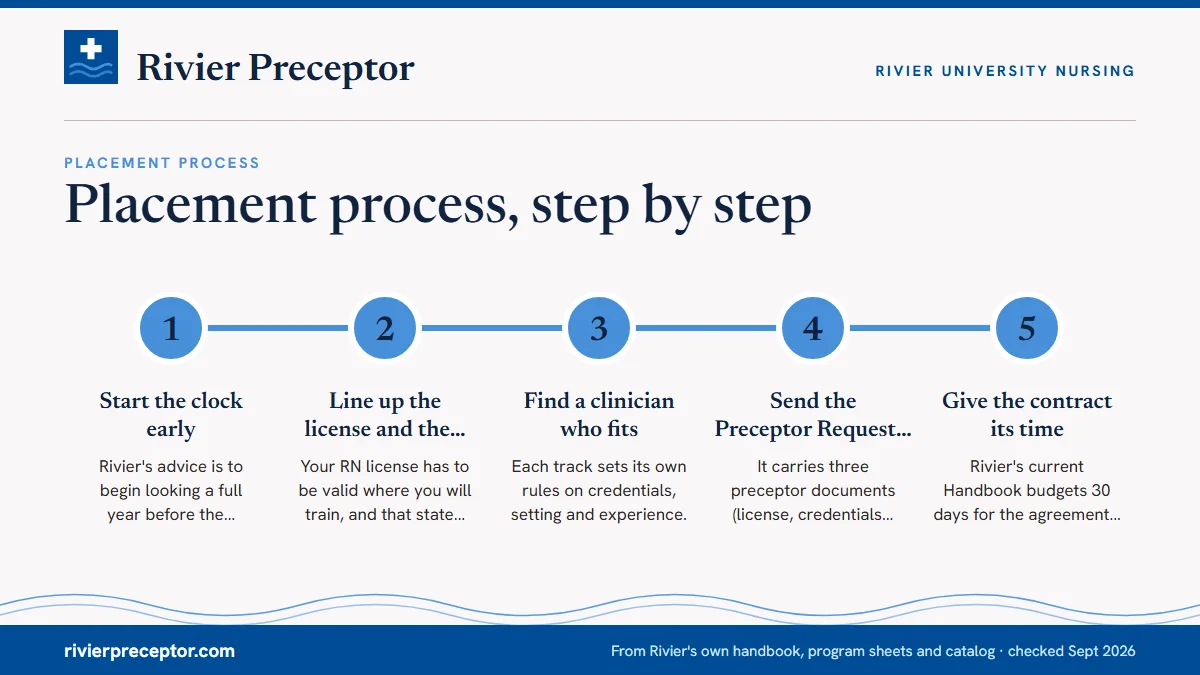
The whole path on one page
Rivier's 2026-2027 Nursing Student Handbook treats placement as your job on every MSN track and post-master's certificate, with the Clinical Practicum Coordinator and faculty in support. Here is the sequence the Handbook and Rivier's older practicum form lay out, one line per stage. Every stage has a fuller guide on this site.
- Start the clock earlyRivier's advice is to begin looking a full year before the practicum term.
- Line up the license and the stateYour RN license has to be valid where you will train, and that state has to be open to your track.
- Find a clinician who fitsEach track sets its own rules on credentials, setting and experience.
- Send the Preceptor Request FormIt carries three preceptor documents (license, credentials, CV) and sets the site contract moving.
- Give the contract its timeRivier's current Handbook budgets 30 days for the agreement with the site.
- Close out CastleBranchYour myCB account must be complete four months before practicum courses open.
- Collect both sign-offsFaculty rule on the site, and the coordinator verifies the paperwork and contract.
- Finish onboardingRivier's August CCP orientation, the facility's own orientation, and a printed ticket per clinical experience.
- Begin on opening dayNothing logged before the semester opens counts, and FNP and PMHNP students fit 250 hours inside each practicum term.
A year out: your state and your track's rules
The first decisions are about where and with whom, not forms. Each 2026 graduate program sheet lets you train near home, on the condition that your RN license covers that state. Some states limit out-of-state programs through their nursing board or their labor department, so read Rivier's State Guide before contacting anyone. Planning a move? The Dean expects written word of it 90 days or more beforehand.
Next, pin down who is allowed to precept you. FNP students train under a physician (MD or DO) or an FNP working in outpatient family practice, with two or more years behind them. Psychiatric students train with a PMH-certified nurse or a psychiatrist. Acute care students open with a hospitalist and then move into critical care, while Education and Leadership students work beside a master's-prepared RN in the matching role. The FNP preceptor requirements show how detailed one track's rules run.
Between a year and four months out: the search
This is the long stretch, and Rivier is honest about why. The Handbook calls NP clinical sites scarce, notes that out-of-state students come to New Hampshire hunting for preceptors too, and mentions schools that keep waiting lists. It invites you to put forward clinicians you know through work, and it promises help from faculty and the coordinator in locating a willing clinician, drawing on Rivier's contract resources, while making clear that your preferences may not be met.
A productive search tests each lead against the track rules before the first phone call, checks that the clinician's week can hold a semester of hours, and asks early whether the organization will contract with Rivier. The full method, with questions to settle before any paperwork, lives in finding your own preceptor.
Four months out: two sets of paperwork
Around the four-month mark, two files move side by side. The site file begins with the Preceptor Request Form and the preceptor's documents, which open both the affiliation agreement and the review of your preceptor. Your personal file sits in CastleBranch: immunizations, TB results, this year's background check and drug screen, BLS and the rest, joined by three graduate extras: the RN license for your practicum state, the resume you keep current, and Rivier's clinical information sheet (formally, the Student Information Sheet for Clinical Experience).
Rivier's current Handbook fixes the last possible placement date for every MSN practicum course: fall's is August 1, spring's is December 1. An older 2018 Rivier form printed earlier dates, so the two conflict, and the placement deadlines guide lines them up. Reach that cutoff with no confirmed site, or with gaps in your records, and the Handbook's answer is a one-semester deferral.
Sending a request does not make it approved. Rivier's older form says so outright, and the current Handbook reserves the site decision for graduate faculty.
Approval: two separate sign-offs
Two reviews close the loop, and hour one waits for both. Graduate faculty rule on whether the site suits your course. The coordinator, separately, checks off each required document and the signed contract, and no hour counts until that check is done. Rivier's older form also wants your preceptor approved and the agreement fully executed before you register, and it cautions that early registrants may be made to drop the course.
When a facility's own rules reach further than Rivier's, the facility's rules win. An agency may turn a student away over background check results or a vaccine exemption, and the Handbook states that Rivier is under no obligation to replace the site. A second lead kept in reserve is the practical answer; see when an agency says no and how the coordinator works.
The weeks before your first shift
Onboarding has a short checklist of its own. Every August brings Rivier's online Centralized Clinical Placement orientation, known as CCP, which you complete along with any orientation your facility runs. Rivier also has you print one Clinical Assignment Ticket for every clinical experience, and some agencies hand out their own ID badges. The CCP orientation and Clinical Assignment Ticket guide covers each item.
Agree on a schedule with your preceptor before term begins. On Rivier's 2026-27 academic calendar, Fall 2026 opens on September 8 and Spring 2027 on January 18, and nothing done before opening day counts. Since FNP and PMHNP students cannot move surplus hours into the next practicum, a preceptor who can spare only a few hours a week turns into a real problem by midterm.
Once the semester is running
After hours begin, the practicum runs through your course. A missed shift means an immediate heads-up to your preceptor and a prompt message to faculty, as the Handbook requires. Faculty cannot post a final grade until every required clinical hour is done, and a practicum grade under 84% ends your place in that graduate track, so the schedule you agree at the start carries weight all term.
For NURS 638P through NURS 640P, the 2025-26 catalog has your assigned faculty member watching your clinical logs and reading what your preceptor reports. Your course faculty will explain how hours are recorded in your own course. If anything changes at the site partway through, raise it with them early rather than in the final weeks. For pacing, read the 250 hours per semester guide.
Why Rivier students run this process with us
We are built around this exact sequence. We search for clinicians who already satisfy your track's rules, close to where you live and inside a state Rivier can accept, and we verify each one's credentials, years in the role and availability before you touch a form. We collect the three preceptor documents the request needs, plus the site contact details the contract office will ask for.
We work to Rivier's four-month lead rather than the final cutoff, so your packet lands with the coordinator early and whole. Approval of each site and preceptor stays with Rivier's graduate faculty and its Clinical Practicum Coordinator; our job is making sure the file they open is complete and matches Rivier's rules on the first read. If a preceptor drops or an agency declines, we are already working on the replacement. Share your track and semester in the form below.
Questions Rivier students ask
How long does the Rivier practicum placement process take?
Budget most of a year. Rivier suggests beginning the search a year out and settling the placement a full four months ahead of term. The site contract takes 30 days under the current Handbook, and an older Rivier form warned that processing could stretch to twelve weeks or more, so leave slack at the end.
Should I register for the practicum before approval comes through?
Rivier's older practicum form puts preceptor approval and a completed site agreement ahead of registration and warns that anyone who registers first may need to drop. Ask the Clinical Practicum Coordinator how the sequence works this year before you register, because hours count only after the coordinator has verified your paperwork and contract.
Is the process different for Rivier DNP students?
Yes. DNP students choose an external expert for NURS 895 together with their faculty guide, and a committee signs off on that choice. NURS 715 students agree their goals with the Program Director and practice under a nurse leader. The stages on this page describe the MSN tracks and the post-master's certificates.
Do Rivier BSN students follow these steps?
No. Rivier places its BSN, ABSN and ASN students with clinical agencies itself, and the Handbook allows those agencies to be as far as 60 miles from campus. The preceptor search, the request form and the fall and spring placement cutoffs belong to graduate practicum students.
Which Rivier office should I contact first about a practicum?
Begin with the Clinical Practicum Coordinator, who helps graduate students with the preceptor search alongside faculty and verifies documents and contracts before any hour counts. Your Program Director owns your Program of Studies, requests for alternative hours and questions about states the State Guide marks yellow.
Related pages
Last checked 2026-09-26
We check these pages against Rivier's own Nursing Student Handbook, program sheets, catalog, academic calendar and State Guide. Your program of study, your course faculty, your Program Director and the Clinical Practicum Coordinator have the final word.
Rivier asks you to identify a qualified preceptor. We make that the easy part.
Tell us your Rivier track, where you live and which semester your next practicum starts. We find preceptors who meet your track's rules, check early whether the site can contract with Rivier, and prepare everything the Preceptor Request Form asks for, well ahead of August 1 and December 1.
- Preceptors matched to the track: an MD, DO or FNP in outpatient family practice for
NURS 511, a psychiatrist or PMH-certified NP forNURS 521, a hospitalist or intensivist forNURS 638P - Preceptor license, credentials and CV ready for the Preceptor Request Form, with the site's contact details for the contract
- In your own area, in New Hampshire or any state Rivier's State Guide accepts
Start your placement plan
Track, city and semester is all we need to begin.