Search alone, lean on Rivier, or use a placement service?
At Rivier University, graduate nursing students are expected to line up their own preceptors, but there is more than one way to do it. This page compares three routes (your own network, the help Rivier's faculty and Clinical Practicum Coordinator give, and a placement service) and shows which one fits your situation and your deadline.
Get your placement plan
Tell us your Rivier program and where you live. A placement advisor replies with the preceptor and site options that fit your Rivier course.
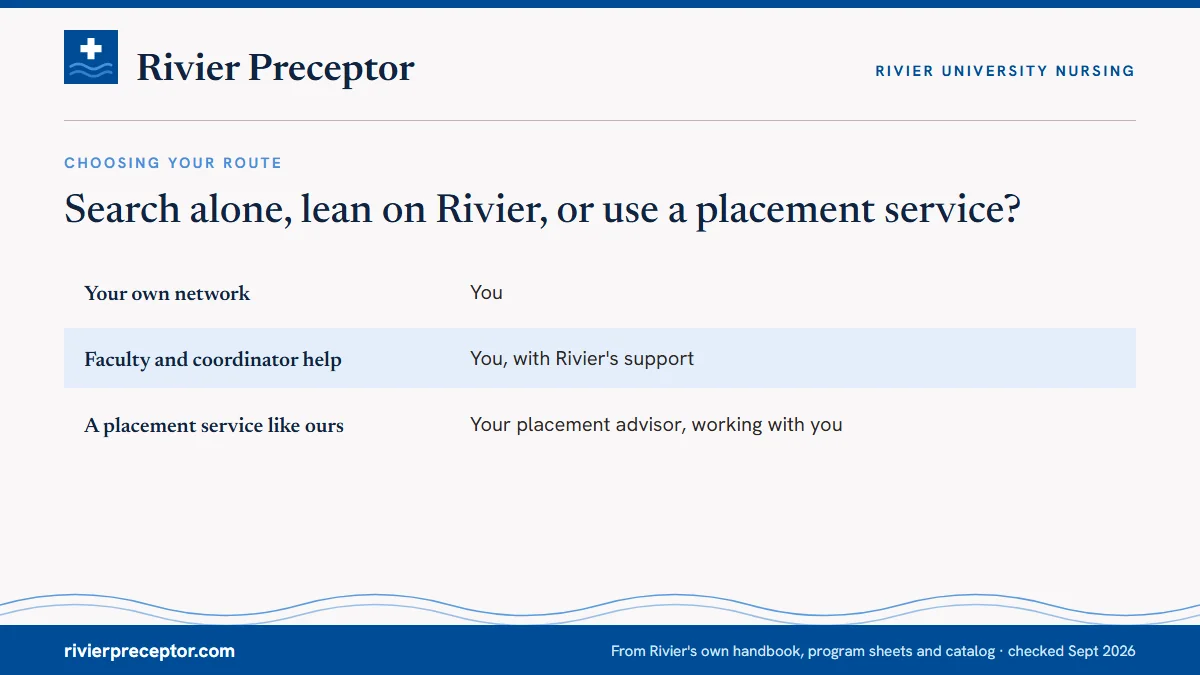
Three routes side by side
Each route can end in an approved placement. They differ in who spends the hours searching, what you receive and when each one tends to work best.
| Route | Who searches | What you get | Works best when |
|---|---|---|---|
| Your own network | You | Clinicians you know professionally, a route the Handbook encourages | You already know a qualifying clinician and have months in hand |
| Faculty and coordinator help | You, with Rivier's support | Help finding an interested preceptor and options within Rivier's contract resources; preferences cannot be promised | You are flexible about location and setting |
| A placement service like ours | Your placement advisor, working with you | A screened preceptor, documents for the Preceptor Request Form, deadline planning and replacements | Time is short, the preceptor type is narrow, or you live far from Nashua |
When your own network is enough
The Handbook invites students to put forward clinicians they know professionally, and for some that is the quickest path. If you work alongside an FNP in an outpatient family practice who has two or more years in practice, and the practice sits in a state Rivier accepts for your program, you may be one conversation away from a preceptor.
This route rewards time in hand. A clinician's willingness is only step one: Rivier and the site still have to sign a contract, and the Handbook allows 30 days for that, while you still need the preceptor's documents for the form. If your contact can cover only one course of a three-course sequence, start planning now for the ones that follow, since each course can call for a different setting.
What leaning on Rivier looks like
Faculty and the Clinical Practicum Coordinator work with students to locate a willing preceptor, and they can offer options drawn from the contract resources Rivier already has. That help is worth asking for early, and the coordinator's feedback on a site you propose is valuable whatever route you use. The Handbook is also candid that it cannot promise your preferences, which matters if you need a site near home or a particular kind of practice.
The same section describes a tight market: NP sites are hard to come by, NP students from programs in other states come to New Hampshire looking for preceptors, and some schools run waiting lists. In practice, Rivier's help works alongside your own search rather than replacing it. The Clinical Practicum Coordinator page explains how to work with that role.
When a placement service is the stronger choice
Students tend to hand the search over when:
- The deadline is less than four months away and no preceptor has said yes.
- The track needs a narrow preceptor type: a hospitalist and then an intensivist for AG-ACNP, or an in-person psychiatric prescriber for PMHNP hours beyond the 300-hour telehealth cap.
- Home is far from Nashua, in a state the State Guide accepts, with no local contacts in advanced practice.
- Full-time work leaves little room for cold calls, yet the practicum still needs 250 hours inside the semester.
- A preceptor withdrew or an agency refused you, and the Handbook does not oblige Rivier to find a replacement site.
In each case the search becomes a job in its own right. The how it works page shows how we run it for Rivier students, from intake to first clinic day.
Questions that settle the choice
- How many weeks remain before your August 1 or December 1 deadline, once you set aside 30 days for the contract?
- Do you personally know a clinician who meets your track's credential and two-year rule?
- Is your practicum state accepted for your program on the State Guide, and are you licensed as an RN there?
- Will one preceptor carry the whole sequence, or will each course need someone new?
- How many hours a week can you give a clinic around work and family?
- If your first choice falls through in October, who is your backup?
When most answers point to little time, few contacts or a narrow preceptor type, a service is the surer path. When you have a strong lead and months to spare, start there and keep a second option warm.
Mixing the routes
You can combine them: keep talking to clinicians you know, tell the Clinical Practicum Coordinator what you are pursuing, and have us run a full search at the same time. When the strongest option emerges, that preceptor goes on the Preceptor Request Form and the others stay in reserve.
Rivier students choose us for that mix of speed and thoroughness. Every candidate is screened against Rivier's track rules before you hear a name, the preceptor's documents are ready for the form, and a replacement search is ready if anything changes mid-semester. What Rivier's reviewers receive is complete from the first submission, which keeps your semester on schedule.
Questions Rivier students ask
Can a Rivier student use a placement service to find a preceptor?
Rivier's Handbook sets out what must be true: a qualified preceptor, a site graduate faculty approve, a contract in place and complete records. A preceptor found through a service goes through the same Preceptor Request Form and approval steps as one you find yourself. Keep the Clinical Practicum Coordinator informed about how you are searching.
Can I switch routes partway through my search?
Yes. Students often begin with their own contacts, then bring in help when a lead goes quiet or the deadline draws near. The earlier you switch, the more options remain. Share what you have already tried, so no clinician is approached twice and no site hears two different stories.
Does using a placement service change Rivier's deadlines or approval?
No. The August 1 and December 1 deadlines, the 30-day contract window, CastleBranch records due four months ahead and faculty approval of the site apply exactly as before. What changes is who does the searching and how complete the request is when it reaches Rivier.
What if I find a preceptor myself after starting with you?
Tell your placement advisor. If your lead meets your track's rules, we help you prepare the documents for the Preceptor Request Form and keep our shortlist as your backup. A backup has real value at Rivier, because hours must fit inside the semester and cannot be carried forward.
Which route is fastest when the deadline is only weeks away?
Usually the one with the most parallel effort. With weeks left, working several qualified leads at once gives the best chance of a yes in time for Rivier's 30-day contract. The need a preceptor fast page sets out a short-deadline plan.
Related pages
Last checked 2026-09-26
We check these pages against Rivier's own Nursing Student Handbook, program sheets, catalog, academic calendar and State Guide. Your program of study, your course faculty, your Program Director and the Clinical Practicum Coordinator have the final word.
Rivier asks you to identify a qualified preceptor. We make that the easy part.
Tell us your Rivier track, where you live and which semester your next practicum starts. We find preceptors who meet your track's rules, check early whether the site can contract with Rivier, and prepare everything the Preceptor Request Form asks for, well ahead of August 1 and December 1.
- Preceptors matched to the track: an MD, DO or FNP in outpatient family practice for
NURS 511, a psychiatrist or PMH-certified NP forNURS 521, a hospitalist or intensivist forNURS 638P - Preceptor license, credentials and CV ready for the Preceptor Request Form, with the site's contact details for the contract
- In your own area, in New Hampshire or any state Rivier's State Guide accepts
Start your placement plan
Track, city and semester is all we need to begin.