The Rivier Preceptor Request Form: what to send and what it starts
The Preceptor Request Form turns a clinician who has agreed to teach you into a request Rivier University can act on. Paired with the preceptor's license, credentials and CV, it opens two reviews at once: the affiliation agreement with the site and the vetting of your preceptor. Neither one means approval yet.
Get your request packet ready
We collect the preceptor documents and site details.
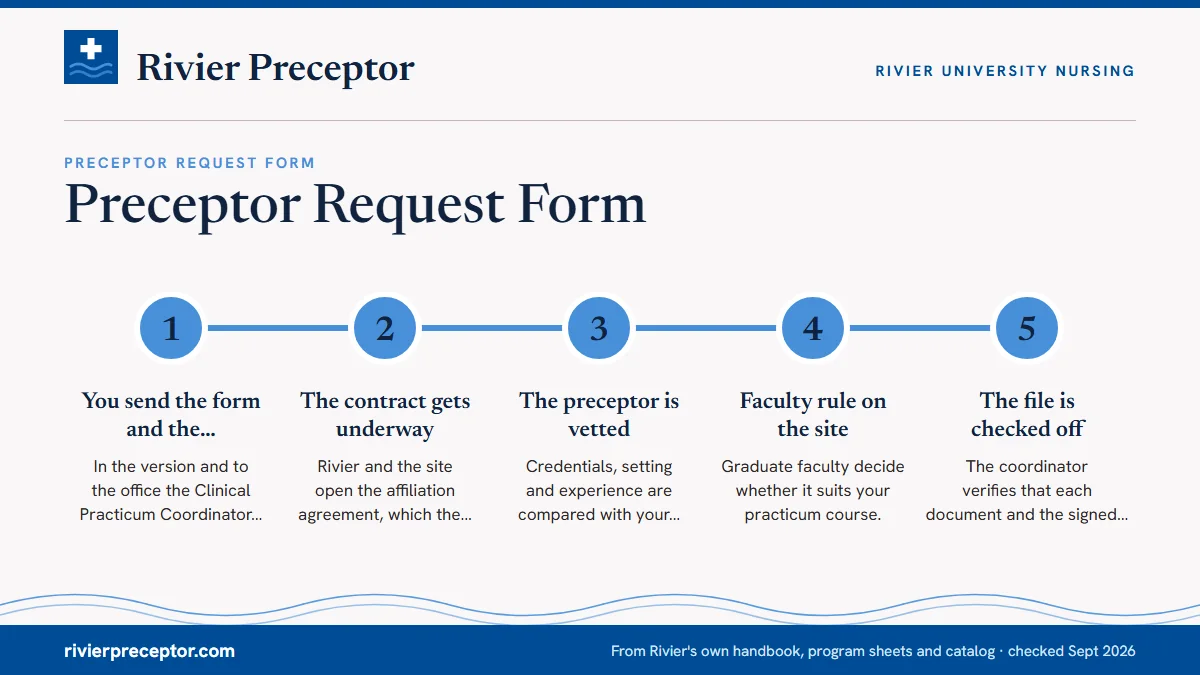
What the form sets in motion
Rivier's practicum form from 2018, still posted on Rivier's site, describes the Preceptor Request Form as the trigger for both the affiliation agreement and the preceptor approval. Back then it went to the MS Practicum Placement Coordinator office; today's Handbook instead places the Clinical Practicum Coordinator at the center of graduate practicum paperwork, so ask the coordinator for the current version of the form and where it goes before you send it.
The older form also spells out something students often miss: opening a request, or even opening an affiliation agreement, is not approval. Approval came from the placement coordinator together with course faculty, and today's Handbook leaves the final ruling on the site's suitability to graduate faculty.
Because one form opens two reviews, a gap in either one stalls both. A preceptor with missing credentials holds up the contract, and a site unwilling to contract leaves even a well-qualified preceptor unusable.
What travels with the form
Gather these from the preceptor and site
- A current copy of the preceptor's license
- Proof of the preceptor's credentials, such as national NP certification or the physician's board specialty
- A CV or resume that shows the present role, the practice setting and the years in it
- The facility's name and street address (the Handbook lists both for alternative-hours requests)
- A named contact at the site for the affiliation agreement, so the contract can start without a hunt
Your personal file stays in CastleBranch rather than on the form: Rivier's Student Information Sheet for Clinical Experience, a fresh resume and the RN license covering your practicum state, along with immunizations and the other items in the CastleBranch requirements guide. The older form also has you sign an acknowledgement of Rivier's Clinical/Practicum Processes and Procedures, and it notes that an approved preceptor then fills in every form Rivier requires.
Check the preceptor against your track first
Submitting a clinician who misses one of the track's rules is the quickest way to lose a month. Hold the CV up against this summary of the Handbook (pp. 74-76) before the form goes anywhere.
| Track | Qualified preceptor | Watch for |
|---|---|---|
FNP (NURS 511, NURS 513, NURS 515) | MD, DO or FNP in outpatient family practice, two or more years in practice | A PA may fill in but cannot be the primary preceptor |
PMHNP (NURS 521, NURS 523, NURS 525) | Psychiatrist or PMH-certified nurse, two or more years in practice | No more than 300 of 750 hours with a telehealth prescriber |
AG-ACNP (NURS 638P, NURS 639P, NURS 640P) | Hospitalist MD or certified AG-ACNP for Practicum I; intensivist or AG-ACNP in critical care for II and III | No telehealth |
Nursing Education (NURS 559P) | RN with a master's degree working as a nurse educator | Hospital or academic setting |
| Leadership | RN with a master's degree (business accepted) in a nurse leadership role | Practicum course numbers differ between the 2026 sheet and the catalog |
From submission to a confirmed site
- You send the form and the preceptor's documentsIn the version and to the office the Clinical Practicum Coordinator names.
- The contract gets underwayRivier and the site open the affiliation agreement, which the current Handbook gives 30 days.
- The preceptor is vettedCredentials, setting and experience are compared with your track's rules.
- Faculty rule on the siteGraduate faculty decide whether it suits your practicum course.
- The file is checked offThe coordinator verifies that each document and the signed contract are in.
- You register and begin on opening dayThe older form puts approval and a signed agreement ahead of registration, and hours never start before the semester does.
Registering ahead of that sequence carries a cost: under the older form, anyone who registers before approval may be told to drop the course. The contract stage has its own guide, affiliation agreements.
Two sets of dates for the same form
The 2018 form names May 1 as the fall cutoff and September 1 as the spring cutoff, and it warns that processing can run twelve weeks or more. Rivier's 2026-2027 Handbook sets a different calendar: absolute placement deadlines for all MSN practicum courses (fall: August 1; spring: December 1), 30 days for the site contract, and a recommendation to have the placement secured four months before term.
The current Handbook governs 2026-27, so its dates lead. The older timeline still earns its place as a warning about how long reviews can take. Sending the form around the four-month mark satisfies the Handbook and leaves room for the slower processing the older form describes. The placement deadlines guide works the dates backward for each semester.
Mistakes that send a request back
- A preceptor with under two years in practice on an FNP or PMHNP request
- An FNP primary site outside outpatient family practice, or an alternative-hours site in a specialty Rivier does not approve, such as dermatology, orthopedics, sports medicine, ENT, GI, oncology, or hospice and palliative care
- A form sent without the license, the credentials or the CV
- A CV that stops short of the current job or leaves the years in the role unclear
- A site that has not yet agreed to sign a contract with Rivier
- An acute care request built around telehealth, which Rivier does not allow on that track
- A request sent after the fall or spring cutoff, which leads to being asked to defer
A single missed track rule, such as a PA named as the lead FNP preceptor, can stall the whole request.
How we build your form packet
For us the Preceptor Request Form is the finish line of the search, not its start. Every clinician we bring you has already been checked against your track's rules, and before the form is filled in we collect the license, proof of credentials and a current CV, the facility's name and address, and a named contact for the site contract.
We time the submission to Rivier's four-month lead, so the fall or spring cutoff is a backstop rather than a target, and we keep a second qualified preceptor in view until your contract is confirmed. The site and preceptor decisions stay with Rivier's graduate faculty and Clinical Practicum Coordinator; our part is making sure the packet on their desk is whole and squares with Rivier's rules at first review.
Questions Rivier students ask
Where do I get Rivier's Preceptor Request Form?
Ask the Clinical Practicum Coordinator for the current version. The copy posted on Rivier's site belongs to an older 2018 practicum document that also carries the earlier May 1 and September 1 dates, so confirm both the form and the deadline with the coordinator before you send anything.
Does submitting the Preceptor Request Form mean my preceptor is approved?
No. Rivier's older form says plainly that opening a request or an affiliation agreement is not approval. The placement coordinator and course faculty approve requests, graduate faculty rule on the site, and the Clinical Practicum Coordinator must check off every document and the contract before your hours count.
What does my preceptor need to provide?
A current license, proof of credentials and a CV or resume. The older form adds that an approved preceptor fills in all of Rivier's required forms, and for alternative hours the current Handbook asks for the preceptor's resume plus the facility name and street address. The site must also be willing to sign a contract with Rivier.
Can I request a preceptor in a state other than New Hampshire?
Yes, as long as you hold an RN license in that state and Rivier's State Guide accepts it for your track. Rivier's program sheets allow practicums in your own geographic area, but a few states restrict out-of-state programs, so confirm your state's status before you build the request.
What if my preceptor's CV is out of date?
Ask for a refreshed copy before you submit. The CV is how the preceptor's current role, practice setting and years of experience get matched to your track's rules, and FNP and PMHNP preceptors need two or more years in practice. A CV that ends a job or two ago invites a question that can cost you time.
Related pages
Last checked 2026-09-26
We check these pages against Rivier's own Nursing Student Handbook, program sheets, catalog, academic calendar and State Guide. Your program of study, your course faculty, your Program Director and the Clinical Practicum Coordinator have the final word.
Rivier asks you to identify a qualified preceptor. We make that the easy part.
Tell us your Rivier track, where you live and which semester your next practicum starts. We find preceptors who meet your track's rules, check early whether the site can contract with Rivier, and prepare everything the Preceptor Request Form asks for, well ahead of August 1 and December 1.
- Preceptors matched to the track: an MD, DO or FNP in outpatient family practice for
NURS 511, a psychiatrist or PMH-certified NP forNURS 521, a hospitalist or intensivist forNURS 638P - Preceptor license, credentials and CV ready for the Preceptor Request Form, with the site's contact details for the contract
- In your own area, in New Hampshire or any state Rivier's State Guide accepts
Start your placement plan
Track, city and semester is all we need to begin.