Rivier's AG-ACNP: hospital and ICU preceptors for 750 acute care hours
Rivier University's Practicum Placement Policy covers every graduate nursing student, so AG-ACNP students identify their own preceptors as well, and on this track the sites are hospitals. Practicum I needs a hospitalist, Practicums II and III need a critical care preceptor, and each asks for 250 supervised hours in its semester. This guide lays out the track, the sequence and the timing.
Plan your acute care practicums
Tell us when Practicum I begins and where you work. Your placement advisor starts with the hospitalist search.
The placement rule, applied to acute care
The AG-ACNP sits under the same graduate policy as every MSN track, summed up on page 73 of the Nursing Student Handbook: "It is the student's responsibility to identify a qualified preceptor." No separate AG-ACNP sentence says who secures the site, but the Handbook does spell out which preceptors this track accepts, and graduate faculty rule on whether each hospital setting is appropriate.
Acute care changes the shape of the search. Your preceptor works inside a hospital, so Rivier's agreement is with a hospital or health system, and those organizations write their own terms for students. Dartmouth Health's student page, for example, says it takes students only from currently affiliated schools and gives its own employees priority.
Faculty and the Clinical Practicum Coordinator can steer you toward an interested hospitalist or ICU clinician and toward hospitals within Rivier's contract resources. An older Rivier form adds that an agency's requirements override Rivier's own, so plan for facility orientations and agency ID cards on top of your CastleBranch (myCB) file.
The AG-ACNP track in numbers
| Item | What Rivier lists |
|---|---|
| Format | Online coursework with ten days on campus |
| Credits | 48 on the 2026 sheet (48 to 54 on the page; Bridge and RN-MSN paths 54) |
| Estimated length | 3.5 to 5 years |
| Terms | 7- and 14-week courses; NSG404, NSG409 and NSG517 run seven weeks |
| Start terms | September, January or May; the next listed start is January 19, 2027 |
| Admission | Active, unencumbered RN license, plus BLS and ACLS certification |
| Certification | AGACNP-BC, through AACN or ANCC per the catalog |
The credit total has a loose end. Add up the courses on the 2026 sheet and you reach 45, not the 48 it states, because BUSS 559 Healthcare Finance is missing. The catalog does carry BUSS 559 and a 48-credit degree, though the heading over that same list reads "Core Requirements (46 Credits)." Your Program of Studies settles which courses you take.
Skills labs first, then three practicums
The AG-ACNP runs on a fixed seasonal pattern. You spend a year on acute care theory with two one-credit skills labs, then move through a fall, spring, fall run of practicums, each paired with a one-credit seminar.
| Course | Term | Hours and notes |
|---|---|---|
NURS 635 Acute Care Skills Lab I | Fall, with NURS 630 | 1 credit |
NURS 636 Acute Care Skills Lab II | Spring, with NURS 631 | 1 credit |
NURS 638P Practicum I with NURS 638S | Fall | 250 directly supervised hours; needs NURS 631 and NURS 636 |
NURS 639P Practicum II with NURS 639S | Spring | 250 hours |
NURS 640P Practicum III with NURS 640S | Fall | 250 hours, bringing the total to 750 |
In every practicum, faculty keep watch on your clinical logs and read what your preceptor reports about you. No logging platform is named in Rivier's documents, so check with your course faculty on how logs reach them. Course detail is on Rivier's AG-ACNP practicums.
Three placements, two kinds of unit
Practicum I (NURS 638P) calls for a hospitalist on an acute care service, either a physician or a certified AG-ACNP. Practicums II and III shift into critical care, precepted by an intensivist or another physician or by an AG-ACNP, and an ICU or ER may stand in for the hospitalist setting. Practicums II and III may each set aside as many as 90 hours for listed acute care specialties, and no stage allows telehealth hours.
In practice that is two different searches: a hospitalist service first, then one or two critical care teams. Finding both inside one hospital keeps travel and onboarding simpler, though each preceptor still goes through Rivier's approval on their own. The full list is on AG-ACNP preceptor requirements.
Shift patterns deserve a question up front. 250 hours across a 14-week semester works out to roughly 18 hours a week, so a preceptor working three long shifts can host you on a steady schedule, while one with an irregular rotation may leave gaps you can't make up after the semester ends.
Deadlines on a fall, spring, fall schedule
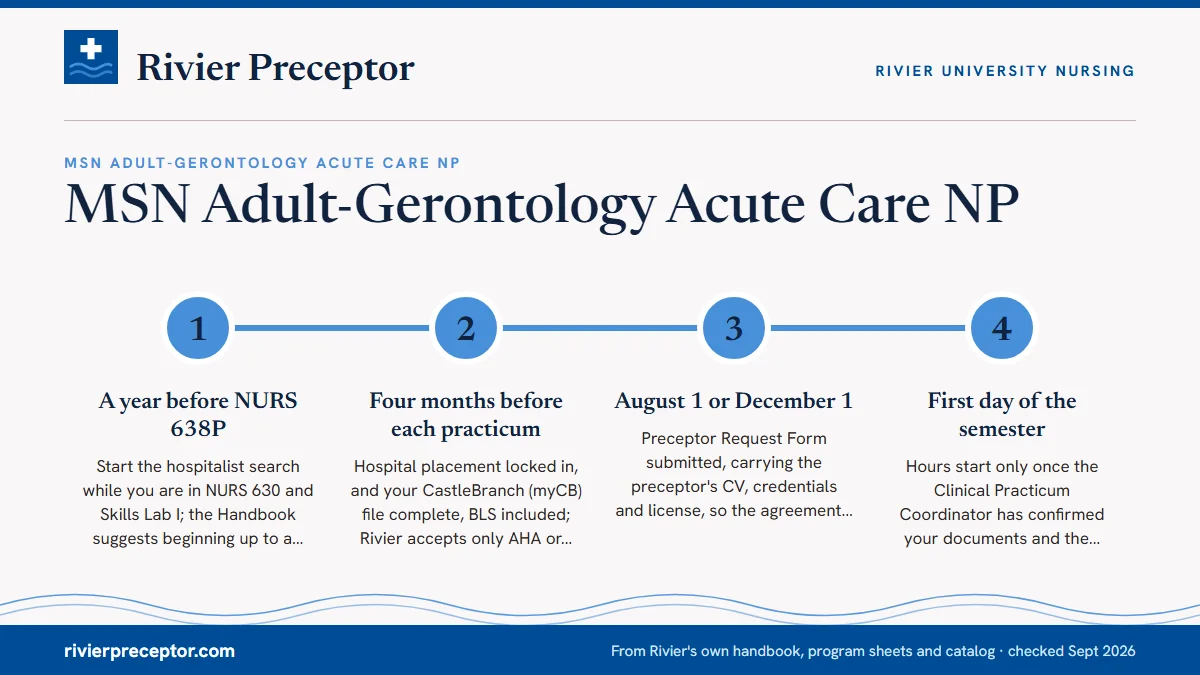
Because the catalog fixes each practicum's term, AG-ACNP deadlines are easy to predict. NURS 638P and NURS 640P run in fall, so the Handbook's August 1 absolute deadline governs both; NURS 639P runs in spring, so it answers to December 1. The Handbook's preferred target comes earlier, with the hospital secured four months out and 30 days reserved for Rivier's agreement with it.
- A year before
NURS 638PStart the hospitalist search while you are inNURS 630and Skills Lab I; the Handbook suggests beginning up to a year ahead. - Four months before each practicumHospital placement locked in, and your CastleBranch (myCB) file complete, BLS included; Rivier accepts only AHA or Red Cross BLS, and it must never lapse.
- August 1 or December 1Preceptor Request Form submitted, carrying the preceptor's CV, credentials and license, so the agreement has time to finish.
- First day of the semesterHours start only once the Clinical Practicum Coordinator has confirmed your documents and the agreement.
A 2018 Rivier form gave May 1 and September 1 and warned of 12 weeks or more for processing. Ask the Clinical Practicum Coordinator which set of dates applies to you, and see placement deadlines for how the two sets compare.
Campus days and the State Guide gap
The AG-ACNP includes ten days on campus at Rivier's Nashua home, where Sylvia Trottier Hall's simulation center keeps labs for NP training. The 2026-27 calendar prints dates only for the FNP intensives, so get the AG-ACNP dates from the Program Director; campus intensives collects what Rivier has published.
Rivier's State Guide has no AG-ACNP column. It shows FNP, PMHNP, Education, Leadership, the DNP and the undergraduate programs, and it is an acceptance guide rather than a licensure determination. Living beyond New Hampshire, ask the Program Director before applying whether Rivier can accept an AG-ACNP student from your state, and hold an RN license wherever your hospital practicum will run; the State Guide page explains the colors for the other tracks.
Relocating mid-program triggers the Handbook's 90-day written notice to the Dean, and checking clinical and licensure barriers in the new state stays your responsibility.
Why AG-ACNP students choose us
We specialize in the hospital searches Rivier's AG-ACNP requires. For Practicum I we find a physician or certified AG-ACNP on a hospitalist service; for Practicums II and III we find critical care preceptors, intensivists, other physicians or AG-ACNPs, who teach you in person near home, with an all in-person plan that respects the no-telehealth rule.
We check that each preceptor's shifts can deliver 250 hours inside the semester, and we assemble the hospital-side paperwork: the preceptor's CV, credentials and license for the request form, plus the facility details Rivier's agreement calls for. Everything is timed to the August 1, December 1, August 1 run of deadlines, with Rivier's four-month lead built in.
When a hospital declines or a rotation changes partway through a term, our team goes straight back to searching and brings you a replacement. Rivier's graduate faculty and Clinical Practicum Coordinator sign off on every acute care site; we deliver an application that is complete and already fits the AG-ACNP rules. Use the form below to start.
Questions Rivier students ask
Do I need ACLS for Rivier's AG-ACNP program?
Yes. ACLS appears next to BLS in the certifications Rivier's graduate admissions page asks AG-ACNP applicants to hold. On top of that, the Nursing Student Handbook makes AHA or Red Cross BLS a standing clinical requirement, current for the whole program and on file in CastleBranch (myCB). Keep your ACLS card current as well so it is ready whenever a site asks to see it.
Can an emergency physician precept my AG-ACNP practicum?
Possibly. The Handbook lets an ICU or ER setting substitute for the hospitalist setting, and Practicums II and III call for an MD, intensivist or AG-ACNP in critical care. Whether a particular emergency physician fits is a graduate faculty decision, so submit their credentials with the Preceptor Request Form and check with your course faculty first.
Can I complete AG-ACNP hours at the hospital where I work?
Rivier publishes no employer rule for this track. The Handbook welcomes clinicians you know professionally, and your hospital still needs a contract with Rivier plus graduate faculty approval of the site. Hospitals set their own student policies; Dartmouth Health's page, for instance, says it prioritizes its employees and takes students only from affiliated schools.
What happens if I fail an AG-ACNP practicum at Rivier?
A practicum finished below 84% (B) ends your place in that graduate track under the Handbook, which then points you to the Readmission Policy. You apply in writing to the Graduate Nursing Admissions Committee, and coming back after a practicum withdrawal means scoring 84% or better on a clinical competency sheet, a result that stays good for only 30 days.
Which exam do Rivier AG-ACNP graduates take?
AGACNP-BC is the credential named on the program page, and the catalog lets graduates certify with AACN or with ANCC. That national certification later counts as one of New Hampshire's APRN licensing items at the OPLC, alongside completing an accredited program and holding a current RN license.
Related pages
Last checked 2026-09-26
We check these pages against Rivier's own Nursing Student Handbook, program sheets, catalog, academic calendar and State Guide. Your program of study, your course faculty, your Program Director and the Clinical Practicum Coordinator have the final word.
Rivier asks you to identify a qualified preceptor. We make that the easy part.
Tell us your Rivier track, where you live and which semester your next practicum starts. We find preceptors who meet your track's rules, check early whether the site can contract with Rivier, and prepare everything the Preceptor Request Form asks for, well ahead of August 1 and December 1.
- Preceptors matched to the track: an MD, DO or FNP in outpatient family practice for
NURS 511, a psychiatrist or PMH-certified NP forNURS 521, a hospitalist or intensivist forNURS 638P - Preceptor license, credentials and CV ready for the Preceptor Request Form, with the site's contact details for the contract
- In your own area, in New Hampshire or any state Rivier's State Guide accepts
Start your placement plan
Track, city and semester is all we need to begin.