The RN license your Rivier practicum needs
Rivier University ties every graduate practicum to one licensing fact: you must be licensed as an RN in the state where the site sits. For a New Hampshire site, either a New Hampshire license or a compact (multistate) RN license issued by a Nurse Licensure Compact state does the job; for a site near home, you need that state's license. DNP students add an APRN layer, and every license has to stay clear for as long as you are enrolled.
Get your placement plan
Tell us your Rivier program and where you live. A placement advisor replies with the preceptor and site options that fit your Rivier course.
The rule: licensed where the practicum happens
Rivier's Nursing Student Handbook makes the practicum's location the test. Before hours begin, you show that you are licensed as an RN in that state, along with your other clinical documents, and Rivier lists this among the very first planning steps, next to its advice to start looking up to a year ahead.
It builds on the admission rule. Rivier admits graduate students with an active, unencumbered RN license, which it verifies, but that license reflects where you work today. The practicum rule asks something else: which state is the site in?
Near a border, the site's address settles it, not your home address. A Nashua student precepting in Lowell needs a license valid in Massachusetts, and a Massachusetts resident precepting in Nashua needs one valid in New Hampshire.
New Hampshire sites: a New Hampshire or multistate license
New Hampshire's licensing office, OPLC, treats a multistate RN license issued by a Nurse Licensure Compact member state as enough to practice there, with no second license needed. If you hold one, it covers a New Hampshire practicum. Check which kind you have before you pick a site: your license record shows whether it is multistate or single-state.
A single-state license from outside the compact works differently: you would add a New Hampshire RN license before hours at a New Hampshire site can count. Build that application into your plan, since Rivier wants the placement secured four months before the semester and contracts take 30 days of their own. More on practicing and precepting in the state is in the New Hampshire guide.
Practicums in your own state
Rivier's 2026 graduate program sheets all allow practicums in the area where the student lives. The license rule then points home: be licensed as an RN in your own state, and the practicum can happen there.
Your state still has to permit it. The Handbook cautions that a state's Board of Nursing, or its Department of Labor, can keep these practicums from going ahead, and Rivier's State Guide names states where it cannot take FNP and PMHNP students at all. Read the State Guide page and practicums outside New Hampshire before you build a search around a site.
If you hold licenses in more than one state, list them all at the start. Each one widens the map of sites that fit Rivier's rule.
The older form's New Hampshire note for FNP campus work
On its 2018 practicum form, Rivier linked FNP campus activities to New Hampshire licensure: FNP students were to hold a New Hampshire RN license for the on-campus work, with the New Hampshire State Board of Nursing given as the reason. That wording belongs to the older form, not to the current Handbook's placement policy.
It still deserves attention, because the FNP track brings students to Nashua for three intensives totaling nine days; the campus intensives page lists the 2026-27 dates. Under OPLC's current guidance, a compact license already lets a nurse practice in New Hampshire.
If you hold a single-state license from somewhere else, ask the Program Director how Rivier reads the older note today, and do it well before your first intensive rather than the week you travel.
DNP students: licensed for the life of the program
Rivier's doctoral rules go a step further. A DNP student must hold an RN license with no encumbrances in whichever state hosts the scholarly project. Students on the Professional Practice track also need an active APRN license, which the 2026 DNP program sheet ties to the state where the practicums will be done.
The consequence of a lapse is spelled out: if a DNP student's license lapses, the Handbook moves that student onto leave of absence, interrupting NURS 895 and the work of the Scholarly Project Team. Renew early, and if the project moves to a new state, settle the license before the move. The doctoral practicum itself is covered in DNP practicums and the external expert.
Moving or renewing mid-program
A move reopens the license question. Changing your state of residence after acceptance calls for written notice to the Dean, sent 90 days or more ahead. The Dean reviews it for known obstacles to clinical placements and to APRN licensure outside New Hampshire, but checking remains your job; moving during your program walks through it.
Renewals are quieter but just as important. Keep your practicum-state license active through every practicum semester, and compare its renewal date with the semester calendar the way you would a BLS card. A license that lapses mid-semester is a compliance gap the Clinical Practicum Coordinator has to act on, and the days away from the site come out of your semester's hours.
After graduation: New Hampshire APRN licensure
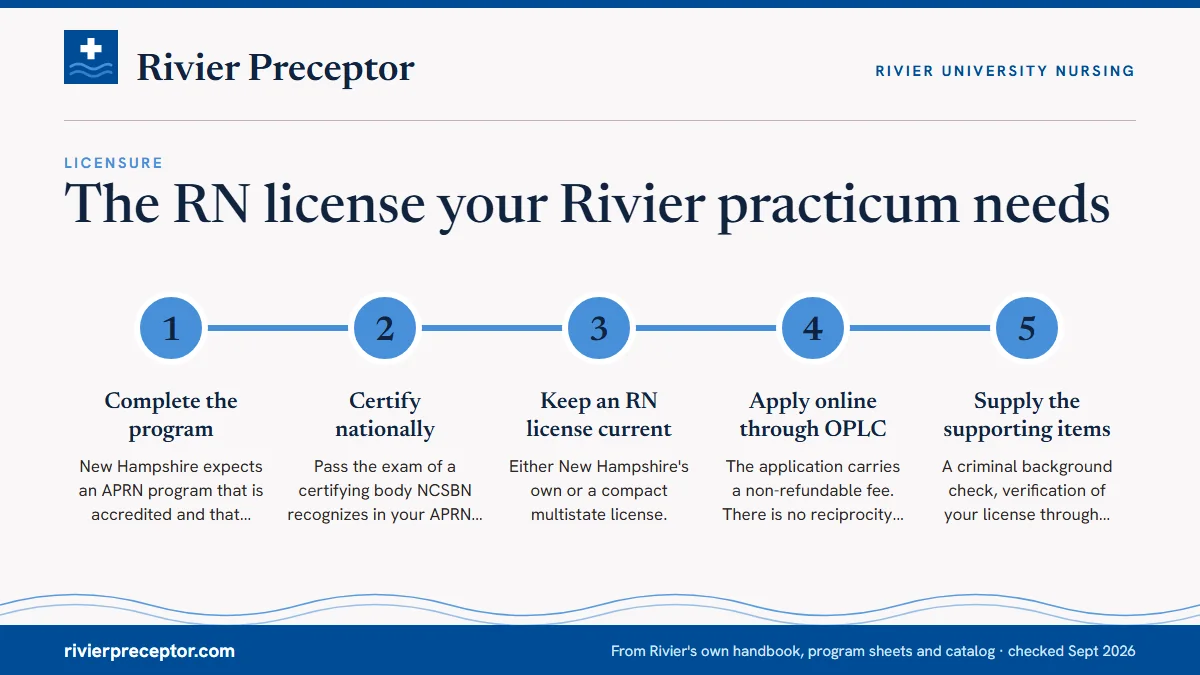
Your practicum license is the RN step. The APRN license comes once the program is finished, and in New Hampshire the path looks like this.
- Complete the programNew Hampshire expects an APRN program that is accredited and that NCSBN recognizes for your specialty; Rivier's standing is on the accreditation page.
- Certify nationallyPass the exam of a certifying body NCSBN recognizes in your APRN specialty.
- Keep an RN license currentEither New Hampshire's own or a compact multistate license.
- Apply online through OPLCThe application carries a non-refundable fee. There is no reciprocity for New Hampshire's APRN license, so APRNs licensed elsewhere start with an initial application as well.
- Supply the supporting itemsA criminal background check, verification of your license through Nursys, and transcripts Rivier sends directly to OPLC.
- Show recent practice hoursThe rule looks for 400 hours of advanced practice within the four years before you apply; ask OPLC whether program clinical hours count toward them.
- Register with the PDMPBefore prescribing opioids, enroll in New Hampshire's Prescription Drug Monitoring Program.
Why Rivier students use us for license-matched searches
Every search we run starts from your license. Before a preceptor reaches you, we check that the site's state matches a license you already hold, or one you can obtain in time, so what you bring to the Clinical Practicum Coordinator meets Rivier's rule on first review.
If you live close to a border, we look on both sides of it wherever your licenses reach, which widens the pool of sites. If a new license would open a better option, we tell you early enough to decide. We assemble the preceptor's CV, license copy and credentials for the Preceptor Request Form and plan around the December 1 and August 1 cutoffs. The form below is the place to begin, and our process page shows what follows.
Questions Rivier students ask
Is a New Hampshire RN license required for every Rivier practicum?
No. It matters only when the site is in New Hampshire and your license is single-state from elsewhere. OPLC accepts a multistate license from a compact state for practice in New Hampshire, so compact holders need nothing extra. For a practicum in your home state, Rivier's rule points to that state's license instead.
Does New Hampshire recognize APRN licenses from other states?
No. OPLC states there is no reciprocity for the APRN license. An APRN licensed in another state files an initial New Hampshire application, backed by national certification, a current RN license from New Hampshire or a compact state, a background check, Nursys verification and transcripts. New Hampshire has no temporary APRN license either.
Can I start a Rivier practicum while my license in that state is pending?
Rivier's rule is that you are licensed in the practicum state, and the Clinical Practicum Coordinator reviews your documents before any hours count, so a pending application falls short. Apply early enough that the license is issued before your placement deadline, and keep the coordinator informed about where the application stands.
What happens if my RN license lapses during Rivier's DNP program?
The Handbook moves a DNP student with a lapsed license onto leave of absence. That applies to the RN license in the scholarly project's state and, on the Professional Practice track, to the APRN license as well. Set renewal reminders well ahead of each expiry date and keep proof of every renewal with your records.
Related pages
Last checked 2026-09-26
We check these pages against Rivier's own Nursing Student Handbook, program sheets, catalog, academic calendar and State Guide. Your program of study, your course faculty, your Program Director and the Clinical Practicum Coordinator have the final word.
Rivier asks you to identify a qualified preceptor. We make that the easy part.
Tell us your Rivier track, where you live and which semester your next practicum starts. We find preceptors who meet your track's rules, check early whether the site can contract with Rivier, and prepare everything the Preceptor Request Form asks for, well ahead of August 1 and December 1.
- Preceptors matched to the track: an MD, DO or FNP in outpatient family practice for
NURS 511, a psychiatrist or PMH-certified NP forNURS 521, a hospitalist or intensivist forNURS 638P - Preceptor license, credentials and CV ready for the Preceptor Request Form, with the site's contact details for the contract
- In your own area, in New Hampshire or any state Rivier's State Guide accepts
Start your placement plan
Track, city and semester is all we need to begin.