Liability coverage, BLS and health insurance at Rivier
Three items in your Rivier University clinical file are about coverage rather than health: Rivier's own professional liability policy, a BLS card issued by the American Red Cross or the American Heart Association, and proof of health insurance. Rivier bills the liability policy each year you are in clinical courses, the BLS card can never lapse, and health insurance has to run for the whole program.
Get your placement plan
Tell us your Rivier program and where you live. A placement advisor replies with the preceptor and site options that fit your Rivier course.
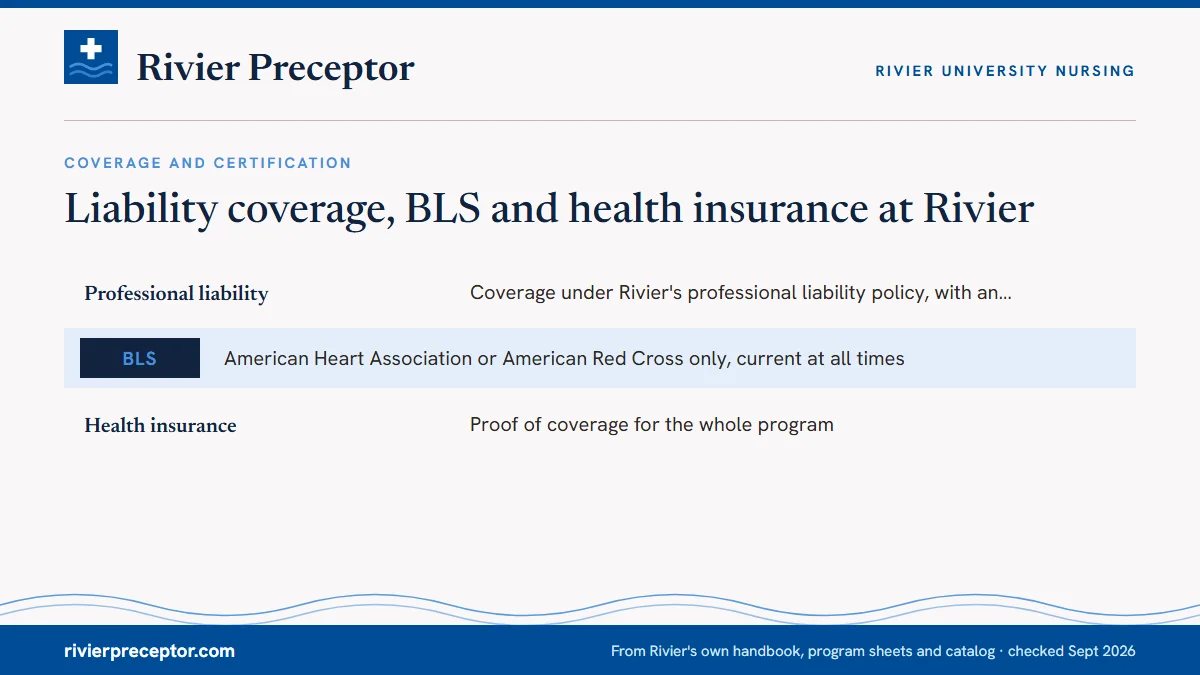
Three coverage items at a glance
These sit in your clinical file with the rest of your requirements, but they behave differently from immunizations. Two of them depend on dates you control, and one is billed by Rivier itself. All three apply to every clinical or practicum course, from an NP practicum to the Nursing Education teaching practicum.
| Item | Rivier's rule | Arranged by |
|---|---|---|
| Professional liability | Coverage under Rivier's professional liability policy, with an annual fee | Rivier, billed to students in clinical courses |
| BLS | American Heart Association or American Red Cross only, current at all times | You |
| Health insurance | Proof of coverage for the whole program | You |
The full list of clinical requirements, and the four-month due date for graduate records, is on the CastleBranch requirements page.
Rivier's professional liability policy
Rivier requires each student in a clinical course to carry coverage through the university's own professional liability policy. Rivier charges an annual fee for it to students taking clinical courses, so it recurs for each year you are in practicum rather than once for the program.
Coverage is tied to Rivier's policy specifically. If you already carry a personal malpractice policy as a working RN, it sits alongside Rivier's rather than in place of it, because the Handbook's requirement names the university policy.
If a site asks for proof of student liability coverage during onboarding, ask the Clinical Practicum Coordinator how Rivier provides it rather than sending your personal policy. The fee itself is one of several practicum charges covered in the placement costs guide.
BLS: two providers, and never expired
Rivier accepts Basic Life Support certification from two providers only: the American Heart Association and the American Red Cross. A card from any other organization does not meet the Handbook's rule, even for a course that looks the same.
The second half of the rule is that BLS must be current at all times. A card that expires in the middle of a semester leaves a gap in your compliance from that date, so the safe habit is to renew before the semester starts whenever the expiry falls inside it.
AG-ACNP students carry more. Rivier's graduate admissions page asks AG-ACNP applicants for both BLS and ACLS certification. If you are on that track, ask your Program Director whether ACLS must also stay current from NURS 638P through the last acute care practicum.
Health insurance for the whole program
Rivier asks for proof of health insurance that covers your entire program, not just the semesters with a practicum. A theory-only semester between practicums still needs coverage on record.
Changes of job or plan are where this slips. A new employer often means a new insurer and a new card, so upload fresh proof whenever your coverage changes instead of waiting for someone to notice that the old card no longer applies.
Health insurance sits in the same part of your file as your yearly physical, recorded on the DNHP health record form, and the Authorization to Release Medical Information form. The medical items themselves are covered in the immunizations and TB guide.
Checking expiry dates against Rivier's calendar
The simplest check is to put each date next to the semester it has to cover. These are the 2026-27 semester dates from Rivier's academic calendar.
| Semester | Dates | BLS card and insurance should run past |
|---|---|---|
| Fall 2026 | September 8 to December 18, 2026 | December 18, 2026 |
| Spring 2027 | January 18 to May 7, 2027 | May 7, 2027 |
| Summer 2027 | May 10 to August 26, 2027 | August 26, 2027 |
If a BLS card would expire inside a practicum semester, renew it in the break before. Leave a margin: a renewal class that fills up or reschedules should not push you past the date. Health insurance follows the same logic, with the added rule that Rivier wants it in force for the whole program, practicum or not.
What a lapse costs
Rivier handles a lapsed certification or missing proof like any other compliance gap. Consequences named in the Handbook include losing clinical time, a block on registering and removal from the clinical course, and graduate students can see the practicum paused until the proof is back on file.
For FNP and PMHNP students the real cost is hours. Each practicum semester needs 250 hours inside it, and extra hours cannot be carried forward, so days away from the site are hard to recover. The 250 hours per semester page explains how that rule works.
Rivier requires BLS to be current at all times. A card that runs out mid-semester is a compliance gap, not a paperwork detail.
Why Rivier students hand us the search
We build the placement timeline around dates like these. When we plan your search, we note your practicum semesters and flag anything, such as a BLS renewal or an insurance change, that could fall inside one, so it gets handled in the break rather than mid-rotation.
Our main work is the preceptor: someone who meets your track's rules, in your area, with a schedule that makes 250 hours achievable, plus the CV, credentials and license copy that go with the Preceptor Request Form. Every site still goes to Rivier's graduate faculty for the final decision, with the Clinical Practicum Coordinator confirming the contract, and we make sure the file they receive is complete. The form below starts the conversation; how it works shows each step.
Questions Rivier students ask
Do I need my own malpractice insurance as a Rivier NP student?
Rivier's Handbook requires coverage under the university's own professional liability policy, billed as an annual fee to students in clinical courses. A personal policy is your choice, but it does not stand in for Rivier's. If a site asks for proof of student coverage, ask the Clinical Practicum Coordinator how Rivier supplies it.
Does Rivier accept an online BLS course?
Rivier's rule names the provider, not the format. Your BLS card must be issued by the Red Cross or the American Heart Association and stay current throughout. If you are considering a blended or online option, check that it ends in a card from one of those two, and ask the Clinical Practicum Coordinator if you are unsure.
Do Nursing Education and Leadership students need BLS and liability coverage?
The Handbook wants the full requirement list complete before any clinical or practicum course starts, and the Education practicum (NURS 559P) and the Leadership practicum courses are practicum courses. Plan for the full list, including BLS and Rivier's liability coverage, and confirm any track-specific details with your Program Director.
Can my health insurance lapse between practicum semesters?
No. Rivier asks for proof of health insurance covering the whole program, so theory-only semesters count too. If you change jobs or plans, upload new proof as soon as the new coverage starts. A gap found later can hold up registration or a practicum while it is fixed.
How often does Rivier charge the liability insurance fee?
Every year. Rivier's Handbook describes an annual fee for the professional liability policy, charged to students in clinical courses. Rivier sets and bills the amount. For a full picture of what a practicum year costs, including CastleBranch, testing and agency ID cards, see the placement costs guide.
Related pages
Last checked 2026-09-26
We check these pages against Rivier's own Nursing Student Handbook, program sheets, catalog, academic calendar and State Guide. Your program of study, your course faculty, your Program Director and the Clinical Practicum Coordinator have the final word.
Rivier asks you to identify a qualified preceptor. We make that the easy part.
Tell us your Rivier track, where you live and which semester your next practicum starts. We find preceptors who meet your track's rules, check early whether the site can contract with Rivier, and prepare everything the Preceptor Request Form asks for, well ahead of August 1 and December 1.
- Preceptors matched to the track: an MD, DO or FNP in outpatient family practice for
NURS 511, a psychiatrist or PMH-certified NP forNURS 521, a hospitalist or intensivist forNURS 638P - Preceptor license, credentials and CV ready for the Preceptor Request Form, with the site's contact details for the contract
- In your own area, in New Hampshire or any state Rivier's State Guide accepts
Start your placement plan
Track, city and semester is all we need to begin.