Who pays for what in a Rivier practicum
Rivier University's Nursing Student Handbook places most practicum costs on the student: CastleBranch fees, health testing, the yearly background check and drug screen, an annual professional liability fee, agency ID cards and a higher per-credit rate for clinical courses. This page names each cost and who carries it; for current amounts, check your program page and your bill in Colleague Self-Service.
Get your placement plan
Tell us your Rivier program and where you live. A placement advisor replies with the preceptor and site options that fit your Rivier course.
The short answer, item by item
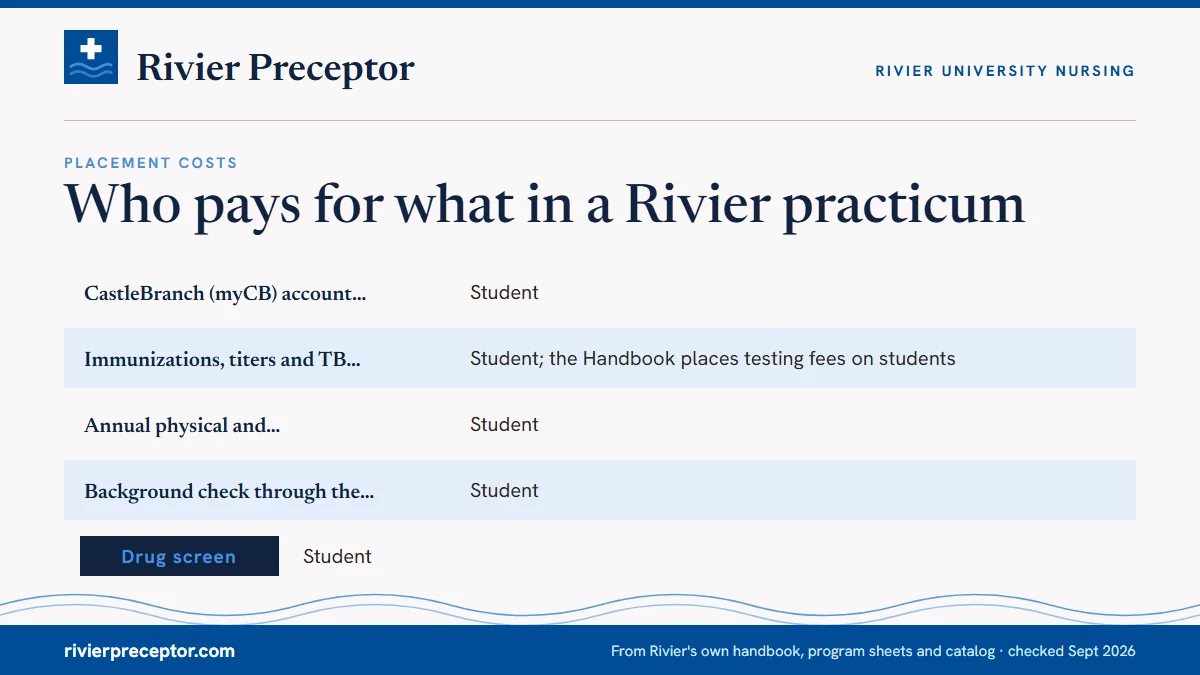
Rivier's Handbook (pp. 14-17) and program pages assign each practicum cost as shown below. Amounts change from year to year, so the table names who pays and how often rather than a figure.
| Item | Who pays | How often |
|---|---|---|
| CastleBranch (myCB) account and associated fees | Student | As records are added and renewed |
| Immunizations, titers and TB testing | Student; the Handbook places testing fees on students | TB testing and flu vaccine every year |
| Annual physical and color-vision test | Student | Physical yearly, on the DNHP health record form |
| Background check through the Division's contracted agency | Student | Every year |
| Drug screen | Student | Every year, plus any random or targeted test |
| Professional liability insurance under Rivier's policy | Student, charged by Rivier | An annual fee while in clinical courses |
| Health insurance | Student | Proof required for the whole program |
| BLS through the AHA or American Red Cross | Student arranges | Kept current at all times |
| Agency ID cards and replacements | Student | When an agency issues or replaces a card |
| Practicum course tuition | Student, at Rivier's clinical-course per-credit rate | Each practicum course |
Compliance costs arrive before the semester
The first practicum bill is the cost of becoming compliant. Every clinical requirement lives in CastleBranch (myCB), and the Handbook states that students pay the associated fees. Graduate students must have everything on record four months before practicum courses, so these costs land months before the term begins.
The list runs long: MMR, varicella and a positive hepatitis B titer, Tdap, a flu vaccine every year by September 30, yearly TB testing, a yearly physical recorded on the Division's health record form, a color-vision test and proof of health insurance. The background check and drug screen come around every year and must go through the Division's own contracted agency.
Records you already hold, such as earlier titers or vaccine documentation, can spare you repeat testing, so gather them before you order anything new. The CastleBranch requirements page explains each item, and the background check and drug screen page covers the yearly checks.
What Rivier itself charges
Two charges come from Rivier directly. Every student in a clinical course is insured under the University's professional liability policy and pays an annual fee for that coverage. Clinical courses are also billed at their own per-credit rate, higher than the standard rate, so a 5-credit practicum costs more than a 5-credit theory course.
Plan for the practicum semesters as the most expensive terms of the program. An FNP or PMHNP student takes three 5-credit practicum courses, each at the clinical rate, and the liability fee recurs for each year of clinical courses. The liability insurance and BLS page explains the coverage itself.
Agencies may issue their own ID cards, and the Handbook puts card and replacement fees on the student. Keep the card safe, since a lost badge brings a replacement fee and can hold up a clinic day.
The costs of time
Some of the heaviest costs never show up as a fee. If your placement is not confirmed, or your records are incomplete, by the August 1 or December 1 deadline, Rivier asks you to defer a semester. That moves graduation back by a term, delays certification and the first NP paycheck, and can mean another round of yearly compliance items before you finish. The delayed graduation page covers that scenario.
Grades carry cost too. A first BC or C puts you on probation for a semester and, in a theory course, means a paid repeat, while falling below 84% in a practicum means dismissal from that track, with readmission sought in writing from the Graduate Nursing Admissions Committee. Withdrawing from a course means a new Program of Studies that may not keep the same practicum term.
Undergraduate students have two further charges in the Handbook: fines for non-compliance and fees for clinical make-up time. Both are avoidable with records kept current and clinical days attended as scheduled.
Travel, campus days and where you practice
Rivier's NP tracks are online with low residency: the FNP carries nine campus days, the PMHNP cohort meets for three weekends, the AG-ACNP MSN has ten days and its certificate eight. If you live away from Nashua, build travel and time off work around those dates; the campus intensives page lists the 2026-27 FNP dates.
Practicum travel is the other variable. Rivier's 2026 program sheets let you complete practicums where you live, and the Handbook warns that NP sites are scarce, with students from other states traveling to New Hampshire for preceptorships. A preceptor close to home, in a state Rivier accepts, keeps mileage, lodging and missed work shifts down.
If your best site sits across a state line, remember that your RN license has to cover the practicum state, which adds its own application and renewal costs.
What shapes the cost of our search
Our placement service is separate from anything Rivier charges, and Rivier students choose it because the search is thorough from the first conversation. Your quote depends on your track and practicum, how many semesters you want covered, the state and area you live in, and how close you are to the August 1 or December 1 deadline. An FNP student planning all three practicums a year ahead is a different search from a PMHNP student who needs a psychiatric preceptor next month.
Each placement includes the same core work: preceptors who satisfy your track's Handbook rules, the preceptor's licensing and CV documents for Rivier's request form, the site details for the contract, and a replacement search if a preceptor drops. Rivier's graduate faculty and Clinical Practicum Coordinator make the approval decision, and we make sure the request in front of them is complete and fits Rivier's rules. Our cost page explains how quotes work; the form below starts yours.
Questions Rivier students ask
Does Rivier charge a separate placement fee for graduate practicums?
Rivier's pages list no separate placement fee. Practicum costs come through the clinical-course per-credit rate, the annual professional liability fee and the compliance costs you pay through CastleBranch and testing. Check current figures on your program page and in Colleague Self-Service, where Rivier posts bills.
Do I have to pay my Rivier preceptor?
Rivier's Handbook does not describe any payment or benefit for preceptors. It frames identifying a qualified preceptor as your responsibility and leaves the final decision on the site to graduate faculty. If a clinician raises payment or any other condition, talk it through with the Clinical Practicum Coordinator before you agree to anything.
Can I use a background check from my employer for Rivier?
No. Rivier accepts only the yearly check run by the agency its Division of Nursing & Health Professions contracts with, so an employer's check cannot stand in. Budget for a new check each year, and keep in mind that an agency can refuse a student based on the results.
Who pays for the flu shot and TB test for Rivier clinicals?
You do. The Handbook places requirement and testing fees on the student, and both items repeat. The flu vaccine is due every year by September 30, the only exemption being a PCP's medical waiver, and TB screening, whether a two-step skin test or a QuantiFERON or T-SPOT blood test, repeats yearly.
Is Rivier's liability insurance fee charged every year?
Yes. Coverage under the University's policy is required for clinical students, and the fee for it recurs annually, as the Handbook describes. Because Rivier charges it, look for it on your bill in Colleague Self-Service. It is separate from the health insurance you must prove for the whole program.
Related pages
Last checked 2026-09-26
We check these pages against Rivier's own Nursing Student Handbook, program sheets, catalog, academic calendar and State Guide. Your program of study, your course faculty, your Program Director and the Clinical Practicum Coordinator have the final word.
Rivier asks you to identify a qualified preceptor. We make that the easy part.
Tell us your Rivier track, where you live and which semester your next practicum starts. We find preceptors who meet your track's rules, check early whether the site can contract with Rivier, and prepare everything the Preceptor Request Form asks for, well ahead of August 1 and December 1.
- Preceptors matched to the track: an MD, DO or FNP in outpatient family practice for
NURS 511, a psychiatrist or PMH-certified NP forNURS 521, a hospitalist or intensivist forNURS 638P - Preceptor license, credentials and CV ready for the Preceptor Request Form, with the site's contact details for the contract
- In your own area, in New Hampshire or any state Rivier's State Guide accepts
Start your placement plan
Track, city and semester is all we need to begin.