Who does what in a Rivier practicum
A Rivier University practicum passes through more hands than you might expect: you, your preceptor, the Clinical Practicum Coordinator, course and graduate faculty, the Program Director and, at certain moments, the Dean. This page lists each role by title, what it handles and when you will need it.
Add a placement desk to your team
We handle the search Rivier assigns to you.
The short answer
For the placement itself, three roles carry the weight. You name a qualified preceptor, which is the student's task under Rivier's Practicum Placement Policy. The Clinical Practicum Coordinator supports the search, sets requirement due dates and verifies your documents and site contract before hours count. Graduate faculty make the final call on whether the site suits your course.
Around them sit the roles you meet when plans shift: the Program Director for your Program of Studies and for exceptions, the Dean for change-of-residence notices and the last step of appeals, and your advisor or Success Coach for leave paperwork. Unless marked otherwise, every title below comes from the 2026-2027 Nursing Student Handbook, and none of these people are named here, only their roles.
Roles in the placement
| Role | What they do in your practicum |
|---|---|
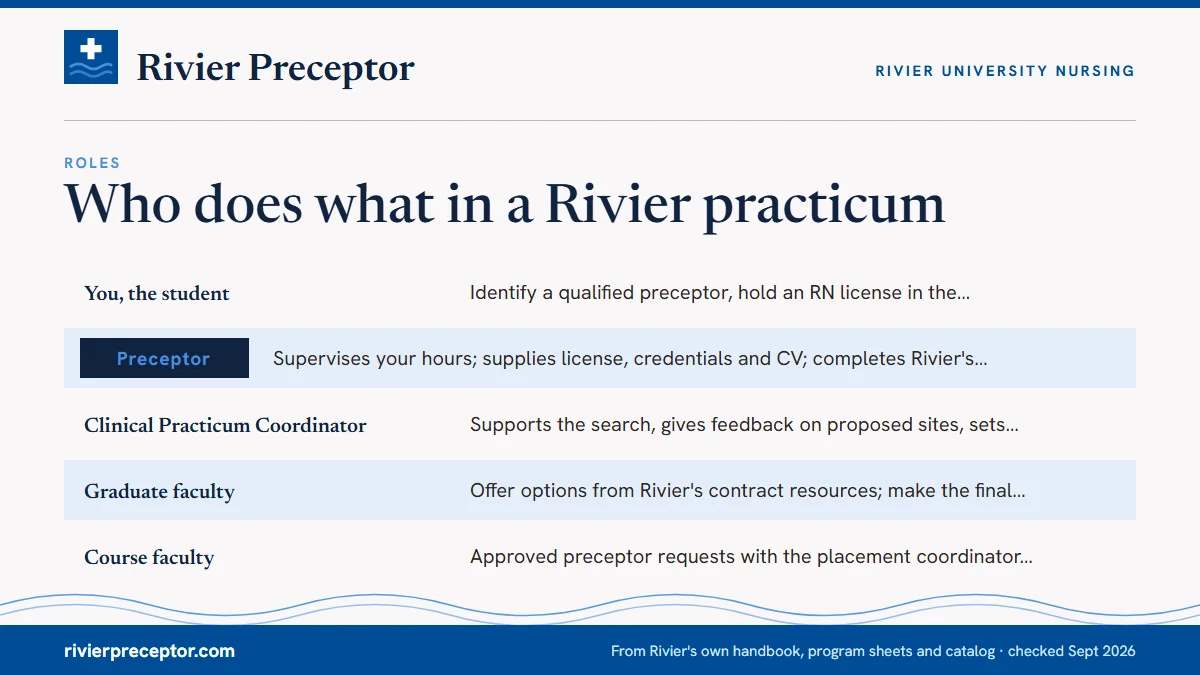
| You, the student | Identify a qualified preceptor, hold an RN license in the practicum state, keep CastleBranch complete, report absences to your preceptor and faculty |
| Preceptor | Supervises your hours; supplies license, credentials and CV; completes Rivier's preceptor forms once approved (older 2018 form) |
| Clinical Practicum Coordinator | Supports the search, gives feedback on proposed sites, sets CastleBranch due dates, verifies documents and contracts before hours count |
| Graduate faculty | Offer options from Rivier's contract resources; make the final decision on whether a site is appropriate |
| Course faculty | Approved preceptor requests with the placement coordinator (older form); hear about absences; issue Written Notices; in acute care practicums, oversee clinical logs and preceptor feedback |
| Program Director | Reviews alternative NP hours with the coordinator; answers yellow-state questions on the State Guide; rebuilds your Program of Studies |
| Practicum site (agency) | Signs the contract with Rivier; may add its own requirements, orientation and ID badges; may refuse a student |
The split between the coordinator's checks and faculty's judgment is explained on the Clinical Practicum Coordinator page, and the order in which these roles appear is laid out in the placement process.
Roles when your plan changes
| Situation | Who handles it |
|---|---|
| You withdraw from a course | Contact the Program Director within 14 days for an updated Program of Studies |
| You need a leave of absence | Request it in writing to the Director of Graduate Nursing Education; the form goes to your advisor or Success Coach |
| You plan to move to another state | Written notice to the Dean at least 90 days before the move |
| Your course average drops below B | Your instructor issues a Written Notice with an improvement plan; after three in a year, you meet the Program Director within 14 days |
| You appeal a grade | The instructor first, then the MS Nursing Faculty Committee within 10 calendar days, then the Dean |
| You seek readmission | The Graduate Nursing Admissions Committee, which meets at the end of each semester; the Dean decides within two business days |
| You return to the FNP track after leave | A re-entry assessment in the Simulation Lab |
Each of these has its own guide: leave, withdrawal and readmission and moving during your program.
Leadership titles you will see
At the top of the nursing chain sits the Division's Dean, who also serves as Rivier's Vice President for Academic Affairs. The Dean receives the 90-day change-of-residence notices and uses them to flag known barriers to clinicals and to APRN licensure in other states, although checking those barriers remains your job. The Dean also hears the final step of a grade appeal, decides readmission cases, and approves written requests to extend Rivier's time limits of six years for a master's degree and seven for a doctorate.
Below the Dean, the Director of Graduate Nursing Education, listed on the program sheets as the Graduate Nursing Education Program Director, oversees the MSN tracks, and the Director of Doctoral Nursing Education oversees the DNP. In 2026-27 a single person holds both posts. The undergraduate programs have their own Director and Assistant Director of Undergraduate Nursing Education.
DNP roles
The DNP adds a team of its own. In NURS 895, your Scholarly Project Team is three people: you, a faculty guide and an external expert. The expert is someone you and the guide choose together, a committee approves that person, and the Handbook notes that faculty provide orientation for the preceptor or mentor.
NURS 715 is added for Systems Leadership students whose master's program supplied under 500 supervised hours; in it, they set their aims with the Program Director and train under a nurse leader. Throughout the DNP, you keep an unencumbered RN license, plus an APRN license on the Professional Practice track, in the state where the project runs, and if either lapses, Rivier places you on leave of absence. The DNP practicums guide covers the team and the 1,000 hours.
Support roles outside nursing
Several university offices touch practicum life without deciding anything about your site. Knowing them saves time when a system problem gets in the way of clinical work.
- Academic advisor or Success Coach: the first contact for Rivier Online students facing a hardship, and the person who receives the graduate leave-of-absence form.
- Registrar: registration, withdrawals and academic records, handled through Colleague Self-Service.
- Nursing Simulation and Clinical Education Center: the labs in Sylvia Trottier Hall, including the Simulation Lab where returning FNP students complete their re-entry assessment.
- IT Support: service requests through its work-ticket system, plus an in-person support center in Sylvia Trottier Hall.
- Regina Library: research databases, interlibrary loan and research guides, with access canceled while you are on leave or after you withdraw.
The student systems guide explains Canvas, CastleBranch, Colleague Self-Service and the rest.
Where we fit alongside Rivier's roles
We take on the part of the work Rivier's policy gives to you: finding a qualified preceptor and assembling what the request needs. We screen clinicians against your track's rules, confirm the site can contract with Rivier, and get the preceptor's paperwork (license, credentials, CV) ready for the request form well before the four-month mark.
Every other role on this page keeps its job. Faculty judge the site, the coordinator verifies the file, your Program Director manages your plan and your course faculty run the practicum; our part is handing them a file with nothing missing and nothing outside Rivier's rules. Should your preceptor leave or a site back out, finding the next one is on us. Start with the form below.
Questions Rivier students ask
Who is my first contact for a Rivier practicum question?
For preceptors, documents, contracts or requirement due dates, the Clinical Practicum Coordinator. For your course plan, alternative hours or a state shaded yellow on the State Guide, the Program Director. For a problem inside a practicum that is already running, your course faculty, right after you have told your preceptor.
Who decides whether my Rivier practicum site is approved?
The final ruling on a site's fit belongs to graduate faculty. Separately, the Clinical Practicum Coordinator verifies that every document and the site contract are in place before hours count. Rivier's older practicum form also had course faculty approving preceptor requests together with the placement coordinator.
Who do I tell if I move to another state during the program?
Put it in writing to the Division's Dean no later than 90 days ahead of moving. That notice lets the Dean point out barriers Rivier already knows about, for clinicals or for APRN licensure elsewhere, though researching them is still up to you. Look up your new state on Rivier's State Guide as well.
Does the Success Coach help with practicum placement?
Rivier's older practicum form listed the advisor among those who help identify potential preceptors, but the current Handbook names faculty and the Clinical Practicum Coordinator for that support. The Success Coach helps Rivier Online students with registration, hardships and withdrawals, and receives the graduate leave-of-absence form.
Who approves my DNP external expert?
A committee. For NURS 895, you and your faculty guide identify an external expert in your project topic, and the committee approves that person to join your Scholarly Project Team. Faculty then provide orientation for the preceptor or mentor, according to Rivier's Handbook.
Related pages
Last checked 2026-09-26
We check these pages against Rivier's own Nursing Student Handbook, program sheets, catalog, academic calendar and State Guide. Your program of study, your course faculty, your Program Director and the Clinical Practicum Coordinator have the final word.
Rivier asks you to identify a qualified preceptor. We make that the easy part.
Tell us your Rivier track, where you live and which semester your next practicum starts. We find preceptors who meet your track's rules, check early whether the site can contract with Rivier, and prepare everything the Preceptor Request Form asks for, well ahead of August 1 and December 1.
- Preceptors matched to the track: an MD, DO or FNP in outpatient family practice for
NURS 511, a psychiatrist or PMH-certified NP forNURS 521, a hospitalist or intensivist forNURS 638P - Preceptor license, credentials and CV ready for the Preceptor Request Form, with the site's contact details for the contract
- In your own area, in New Hampshire or any state Rivier's State Guide accepts
Start your placement plan
Track, city and semester is all we need to begin.