Rivier's Clinical Practicum Coordinator and the faculty who decide
Rivier University's Clinical Practicum Coordinator supports your preceptor search, gives feedback on the sites you propose, and signs off that your paperwork and site contract are complete before any hour counts. Whether the site suits your course is a separate call, and graduate faculty make it. Knowing which person owns which decision saves weeks.
Send the coordinator a finished file
We prepare the preceptor and site details for you.
What the coordinator does, per the Handbook
Rivier's 2026-2027 Nursing Student Handbook sums up the coordinator's work in a handful of lines, and every one of them touches your timeline.
- Partners with faculty to steer you toward a clinician willing to precept (p. 73).
- Responds to the preceptors and sites you put forward with feedback (p. 73).
- Checks that each required document and the site contract are complete; until that check, practicum hours do not count (p. 73).
- Sets the due dates for the clinical requirements you keep in CastleBranch (p. 14).
- Reviews requests for alternative NP practicum hours together with the Program Director (p. 76).
The Handbook uses several versions of the title: Clinical Practicum Coordinator, graduate program clinical practicum coordinator, Clinical/Practicum coordinator and Clinical Coordinator. If an email or form uses a title you do not recognize, ask which office it means before you send anything.
What graduate faculty decide
The coordinator verifies; faculty judge. Under the Handbook, the final ruling on whether a site is suitable for your practicum course rests with graduate faculty, and when faculty help with a search, the choices they put in front of you come from Rivier's contract resources. On Rivier's older 2018 practicum form, course faculty also approved preceptor requests alongside the placement coordinator.
Faculty stay in the picture once hours begin. If you will miss a clinical day, your preceptor hears first and your faculty right after. In the acute care practicums, the 2025-26 catalog gives the assigned faculty member oversight of your clinical logs and your preceptor's feedback. And if your average in a course slips below B, it is your instructor who issues the Written Notice that starts an improvement plan.
Where the Program Director comes in
A third role sits above the placement itself. The Program Director joins the coordinator on alternative-hours requests, rebuilds your Program of Studies if you withdraw from a course (you have 14 days to make contact), and is the person Rivier's State Guide sends you to when your state is shaded yellow. Three Written Notices in one academic year also bring a meeting with the Program Director within 14 days.
Put simply: the coordinator owns documents, contracts and requirement dates; faculty own the site decision and the course; the Program Director owns your plan and its exceptions. Questions about when your practicum happens, rather than where, usually land with the Program Director, because they change your Program of Studies. Every title involved in a practicum is mapped on who does what.
Older titles you may still see
A 2018 practicum form still posted on Rivier's website names a Practicum Placement Coordinator and an MS Practicum Placement Coordinator office. That office received preceptor requests and started affiliation agreements, and its approval, paired with course faculty's, came before registration.
The 2026-2027 Handbook uses Clinical Practicum Coordinator instead. Where the two documents give different dates or processing times, go by the current Handbook; the placement deadlines guide sets both versions side by side. When a form in your hands carries the old title, ask the Clinical Practicum Coordinator where it belongs today, since routing a request to an office name that no longer appears in the Handbook is an easy way to lose a week. Read the older form as background on how Rivier's process has run, not as this year's rulebook.
How to work with the coordinator
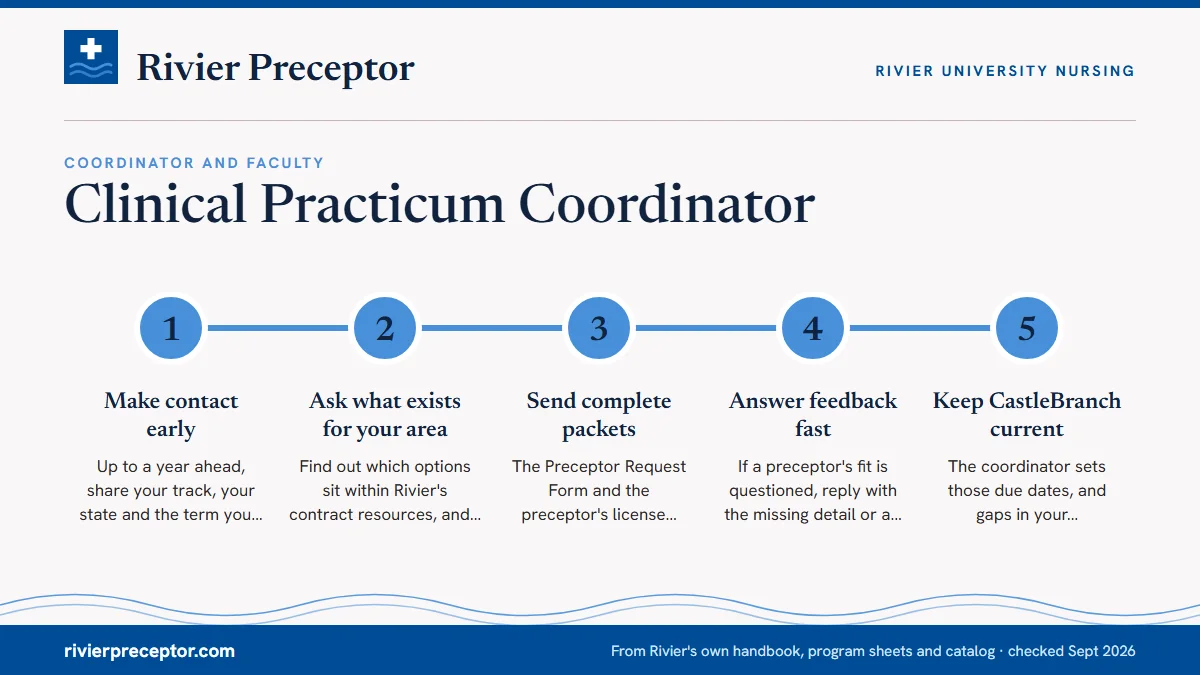
- Make contact earlyUp to a year ahead, share your track, your state and the term you are aiming for.
- Ask what exists for your areaFind out which options sit within Rivier's contract resources, and keep your own search running alongside them.
- Send complete packetsThe Preceptor Request Form and the preceptor's license, credentials and CV together, never in pieces.
- Answer feedback fastIf a preceptor's fit is questioned, reply with the missing detail or a fresh lead within days.
- Keep CastleBranch currentThe coordinator sets those due dates, and gaps in your CastleBranch requirements can suspend a graduate practicum.
- Get the all-clear in writingBefore your first shift, confirm that your documents and the contract have been checked off.
What the coordinator's help does not cover
The Handbook draws clear edges around this role. Options offered by faculty come from Rivier's contract resources and are not promised to match your wishes. If an agency turns you away over a background check or a vaccine exemption, Rivier carries no obligation to find you a different site. And the search itself remains your responsibility under the Practicum Placement Policy.
That is why the students who move fastest bring the coordinator a finished lead rather than a request for one. A preceptor who already clears the track rules, with documents attached and a site ready to contract, turns the coordinator's work into verification. The same goes for timing: a file that arrives near the four-month mark leaves far more room for questions and fixes than one sent in the last days of July. See finding your own preceptor and when an agency says no.
How we make the coordinator's review straightforward
We prepare each placement the way a coordinator hopes to receive it. The clinician we find already clears your track's rules; the license, credentials and CV are current and complete; the site's contract contact is named; and the timing fits Rivier's four-month lead, well ahead of the fall or spring cutoff.
The decisions stay where Rivier puts them: faculty judge the site and the coordinator checks the file. We make sure that file is whole and matches Rivier's rules when it arrives. If the coordinator raises a question, we answer it with you quickly, and if a site falls through, the next lead is already in hand. You stay the student of record and the one who submits; we do the legwork behind it. Use the form below, or see how it works for our process step by step.
Questions Rivier students ask
Is the Clinical Practicum Coordinator the same as the Practicum Placement Coordinator?
Rivier's older 2018 form names a Practicum Placement Coordinator and an MS Practicum Placement Coordinator office. The 2026-2027 Handbook uses Clinical Practicum Coordinator for the graduate role that supports the preceptor search and checks contracts. Use the current title, and ask the coordinator where to send anything that still points to the older office.
Does the Rivier coordinator assign me a preceptor?
No. Under Rivier's Practicum Placement Policy, naming a qualified preceptor is your job. The coordinator and faculty support the search and can offer options from Rivier's contract resources, but no option is promised to match your wishes, and graduate faculty make the final ruling on the site.
Can I start hours as soon as my preceptor agrees?
Not yet. Hours count only after the coordinator has checked off your documents and the site contract, and nothing may begin before the semester's first day. A preceptor's yes opens that review; it does not finish it. Set your first shift for opening day only after the confirmation reaches you in writing.
Who approves alternative practicum hours at Rivier?
The Clinical Practicum Coordinator and the Program Director review them together. The request goes through Rivier's usual approval steps and includes the preceptor's resume plus the facility's name and address. Ask early, because alternative settings carry limits of their own. The alternative hours guide lists which settings Rivier allows.
What happens if I miss the coordinator's CastleBranch due date?
Rivier treats late or missing records seriously: you can be barred from clinical, see a hold placed on registration or be dropped from clinical courses, and graduate students can have the practicum itself paused until everything is filed. The coordinator sets those dates, and graduate requirements are due four months before practicum courses begin.
Related pages
Last checked 2026-09-26
We check these pages against Rivier's own Nursing Student Handbook, program sheets, catalog, academic calendar and State Guide. Your program of study, your course faculty, your Program Director and the Clinical Practicum Coordinator have the final word.
Rivier asks you to identify a qualified preceptor. We make that the easy part.
Tell us your Rivier track, where you live and which semester your next practicum starts. We find preceptors who meet your track's rules, check early whether the site can contract with Rivier, and prepare everything the Preceptor Request Form asks for, well ahead of August 1 and December 1.
- Preceptors matched to the track: an MD, DO or FNP in outpatient family practice for
NURS 511, a psychiatrist or PMH-certified NP forNURS 521, a hospitalist or intensivist forNURS 638P - Preceptor license, credentials and CV ready for the Preceptor Request Form, with the site's contact details for the contract
- In your own area, in New Hampshire or any state Rivier's State Guide accepts
Start your placement plan
Track, city and semester is all we need to begin.