Rivier alternative practicum hours: what counts and how it gets approved
Rivier University lets FNP students spend up to 120 of their 750 hours in approved alternative settings, but only in the courses and specialties its Handbook names. PMHNP and AG-ACNP students work under different limits, and every alternative placement goes through the same approval process as any other site.
Get your placement plan
Tell us your Rivier program and where you live. A placement advisor replies with the preceptor and site options that fit your Rivier course.
Three tracks, three different allowances
The phrase alternative hours means something different on each Rivier NP track. The table puts the Nursing Student Handbook's rules side by side (pp. 74-76).
| Track | What the Handbook allows | Limit |
|---|---|---|
| FNP | Outpatient cardiology, endocrinology or pulmonology, urgent care and telehealth, each in named courses | Up to 120 of 750 hours |
| PMHNP | Time with a prescriber working by telehealth; any age group, inpatient or outpatient | No more than 300 of 750 hours by telehealth |
| AG-ACNP | Listed acute-care specialties during Practicums II and III | Up to 90 hours in each; no telehealth at all |
Most of this page works through the FNP allowance, because it is the one tied to a list of settings and courses. PMHNP and AG-ACNP students will find the full detail on the PMHNP preceptor requirements and AG-ACNP preceptor requirements pages.
The FNP alternative settings, course by course
Rivier's Handbook ties each FNP alternative setting to a particular practicum. It writes the courses as NSG513 and NSG515, while the program sheets call them NURS 513 and NURS 515.
| Setting | FNP Practicum II (NURS 513) | FNP Practicum III (NURS 515) |
|---|---|---|
| Urgent care | Allowed | Allowed |
| Outpatient cardiology | Not listed | Allowed |
| Outpatient endocrinology | Not listed | Allowed |
| Outpatient pulmonology | Not listed | Allowed |
| Telehealth | Not listed | Allowed |
Read the table closely and a pattern appears: no alternative setting is listed for NURS 511. Your first practicum stays in family practice, or in an outpatient internal medicine office if primary care is unavailable. Urgent care opens in Practicum II, and the specialty clinics and telehealth open only in Practicum III, when you are nearest to practicing on your own.
The 120 hours are a ceiling across the FNP program rather than a quota for each course. You can use none of them, split them between urgent care in Practicum II and a pulmonology clinic in Practicum III, or place all of them in NURS 515.
Specialties Rivier does not approve for FNP hours
The Handbook also names settings that are not approved for FNP hours at all, even inside the 120-hour allowance:
- Dermatology
- Orthopedics
- Surgical practices
- Sports medicine
- ENT (ear, nose and throat)
- GI (gastroenterology)
- Oncology
- Hospice and palliative care
Specialists sometimes have room for a student when family practices are full, so offers like these can be tempting, especially from colleagues who want to help. Thank them and keep looking; the Handbook lists these settings as not approved, so the time will not serve your FNP practicum. If the same physician group also runs an approved clinic, such as cardiology or pulmonology, that part of the practice may be able to host you in NURS 515 instead.
A dermatology, orthopedic or GI offer can feel like a lucky break, but Rivier's Handbook lists those settings as not approved for FNP hours.
How an alternative placement gets approved
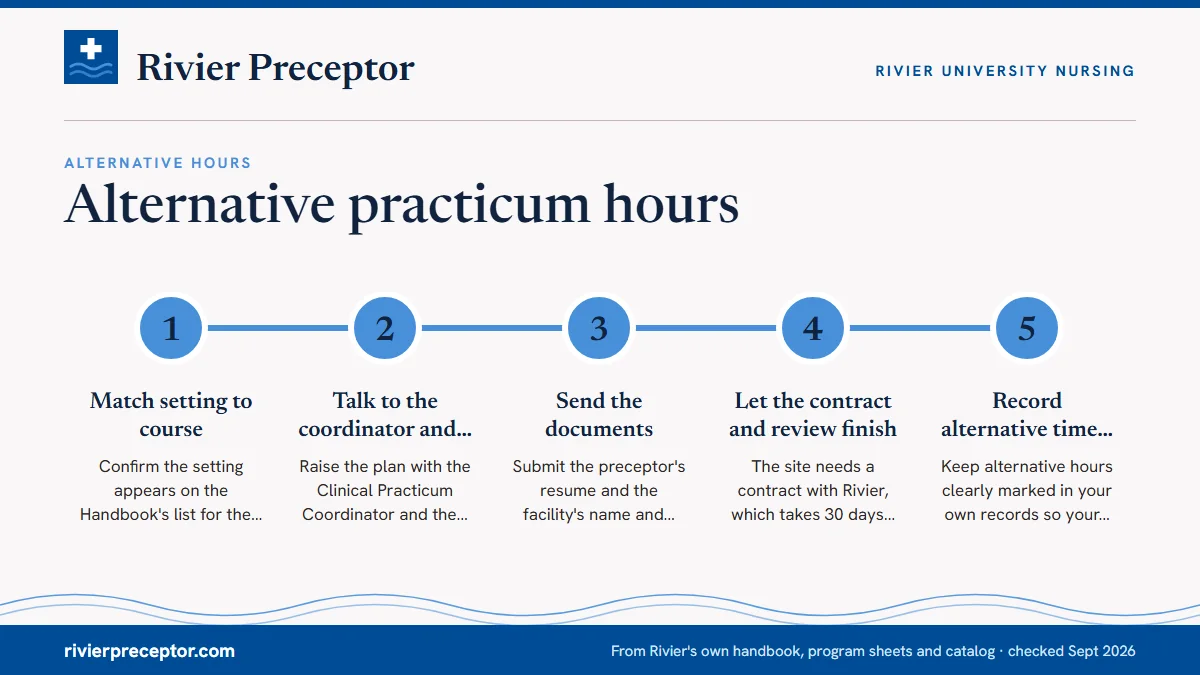
Alternative hours are never automatic. The Handbook asks students who want them to work with the Clinical Practicum Coordinator and the Program Director, and the request travels through Rivier's standard approval process (p. 76).
- Match setting to courseConfirm the setting appears on the Handbook's list for the practicum you will be in, such as urgent care in
NURS 513or endocrinology inNURS 515. - Talk to the coordinator and Program DirectorRaise the plan with the Clinical Practicum Coordinator and the Program Director before you commit a preceptor to dates.
- Send the documentsSubmit the preceptor's resume and the facility's name and address, the items the Handbook names for alternative hours, through the usual Preceptor Request Form route.
- Let the contract and review finishThe site needs a contract with Rivier, which takes 30 days, and graduate faculty decide whether the site suits the course.
- Record alternative time separatelyKeep alternative hours clearly marked in your own records so your running total stays at or under 120.
An alternative site usually runs alongside your family practice, so it carries its own paperwork and timing. Fold it into your plan before the placement deadlines instead of adding it mid-semester.
Why the fallback settings are a separate rule
Two provisions in the Handbook are easy to blur. Page 74 allows an outpatient internal medicine office for Practicum I and a pediatric, OB or women's health setting for Practicum II when primary care is not available. Those substitutes replace a missing family practice.
The 120-hour allowance on pages 75-76 works differently: it adds specialty or remote experience on top of a primary care base. The Handbook does not say whether substitute hours count against the 120, so ask course faculty how your hours will be recorded if you use both.
The FNP total is itself disputed, with 750 hours in the Handbook and 610 in the 2025-26 catalog. The 120-hour figure is written against 750, and our 750 vs 610 hours guide explains what to do about the gap.
How we plan alternative hours for you
Rivier FNP students rely on us because we plan all of your hours, not just the next site. When an urgent care, cardiology, endocrinology, pulmonology or telehealth preceptor would strengthen NURS 513 or NURS 515, we find one who fits Rivier's list and your schedule, and we keep the total inside 120 hours.
We steer you clear of settings the Handbook does not approve before you lose weeks on them, collect the preceptor's resume and the facility's name and address, and time the second contract to Rivier's deadlines. The Clinical Practicum Coordinator, the Program Director and graduate faculty approve every alternative placement at Rivier; what we send them is complete and matched to the Handbook's list from the first page. Tell us about your plan in the form below.
Questions Rivier students ask
Can I do Rivier FNP clinical hours in urgent care?
Yes, within limits. Urgent care is an approved alternative setting in FNP Practicum II or III, and the time counts toward the 120 alternative hours the Handbook allows across the program. It is not listed for Practicum I, and the site still needs approval, a contract and a qualified preceptor.
Does telehealth count toward Rivier FNP hours?
Only in FNP Practicum III. The Handbook lists telehealth as an alternative setting for NURS 515, inside the 120-hour allowance. It is not listed for Practicum I or II, so plan in-person primary care for those semesters and save any remote time for the last practicum.
Can I do FNP hours in dermatology at Rivier?
No. Dermatology is on the Handbook's list of settings not approved for FNP hours, so time there does not count, even within the 120-hour allowance. Look for an approved alternative instead, such as outpatient cardiology or pulmonology in NURS 515, or urgent care in either of the last two practicums.
Is a women's health clinic an alternative setting for Rivier FNP students?
Not in the 120-hour sense. The Handbook lets you use a pediatric, OB or women's health setting for Practicum II when primary care is unavailable, as a substitute for family practice. Women's health is also one of the areas FNP students are required to secure placements in, so ask course faculty how those hours will be recorded.
Does Rivier allow AG-ACNP telehealth hours?
No. Rivier's Handbook allows no telehealth on the AG-ACNP track. Acute care students may use up to 90 hours in each of Practicum II and Practicum III for listed acute-care specialties, but every one of those hours is in person, with the rest in the critical care unit.
Related pages
Last checked 2026-09-26
We check these pages against Rivier's own Nursing Student Handbook, program sheets, catalog, academic calendar and State Guide. Your program of study, your course faculty, your Program Director and the Clinical Practicum Coordinator have the final word.
Rivier asks you to identify a qualified preceptor. We make that the easy part.
Tell us your Rivier track, where you live and which semester your next practicum starts. We find preceptors who meet your track's rules, check early whether the site can contract with Rivier, and prepare everything the Preceptor Request Form asks for, well ahead of August 1 and December 1.
- Preceptors matched to the track: an MD, DO or FNP in outpatient family practice for
NURS 511, a psychiatrist or PMH-certified NP forNURS 521, a hospitalist or intensivist forNURS 638P - Preceptor license, credentials and CV ready for the Preceptor Request Form, with the site's contact details for the contract
- In your own area, in New Hampshire or any state Rivier's State Guide accepts
Start your placement plan
Track, city and semester is all we need to begin.