Who can precept a Rivier FNP student
Rivier University's Nursing Student Handbook sets a clear bar for the Family Nurse Practitioner track. The clinician who supervises your hours has to hold an MD, DO or FNP credential, see patients in an outpatient family setting and bring two or more years of practice. A physician assistant is allowed to fill in, though never as the primary preceptor, and each of the three FNP practicums comes with its own setting and patient-volume expectations.
Get your placement plan
Tell us your Rivier program and where you live. A placement advisor replies with the preceptor and site options that fit your Rivier course.
The three credentials Rivier accepts for FNP
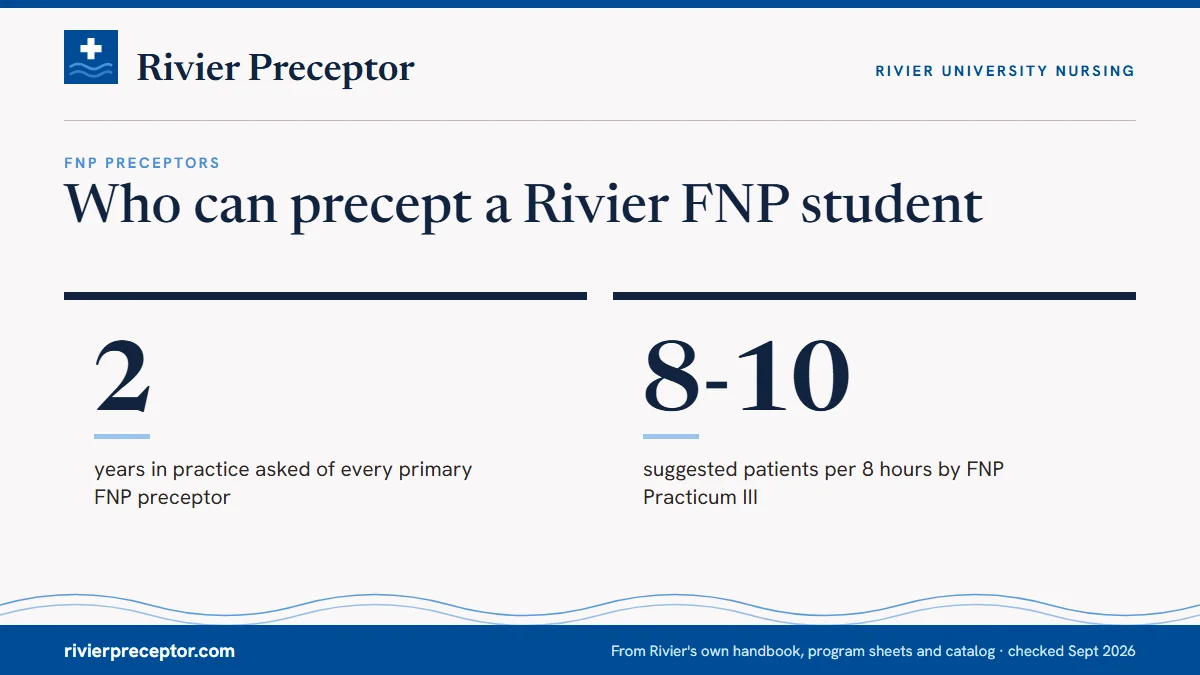
Page 74 of Rivier's Handbook names three kinds of primary preceptor for the FNP track and the FNP post-master's certificate: a doctor of medicine (MD), a doctor of osteopathic medicine (DO) or a family nurse practitioner (FNP). Whichever you choose, the clinician needs at least two years in practice and should be working in an outpatient family practice.
That short list carries more weight than it seems. An NP certified in a different population, a hospital-based specialist or a newly certified FNP in the first year of practice sits outside that wording for your core hours, so check with course faculty before you spend weeks courting one. Graduate faculty rule on each site, and a candidate who plainly fits the Handbook's words is the quickest route to their yes.
| Clinician | Role Rivier allows | Condition |
|---|---|---|
| MD (physician) | Primary preceptor | Two or more years in practice, outpatient family practice |
| DO (osteopathic physician) | Primary preceptor | Two or more years in practice, outpatient family practice |
| FNP (family nurse practitioner) | Primary preceptor | Two or more years in practice, outpatient family practice |
| PA (physician assistant) | May fill in | Cannot be the primary preceptor |
Where a physician assistant fits
Plenty of family practices staff PAs next to their physicians and nurse practitioners, so this comes up in nearly every FNP search. Rivier's answer is precise: a PA may fill in, but a PA cannot be your primary preceptor. The clinician named on your Preceptor Request Form, whose license and CV go to Rivier, should be the MD, DO or FNP.
In day-to-day terms, choose an office where a qualifying clinician carries your schedule, and treat PA time as backup rather than the plan. If your physician preceptor shares a panel with a PA, ask course faculty how much of a semester's hours that PA may supervise before the term begins. An early answer keeps your hours from being questioned when the course closes.
Family practice first, then Rivier's fallbacks
The Handbook says FNP students "are required to secure clinical placements" across primary care, long-term care, pediatrics and women's health (p. 75). Outpatient family practice is the anchor because one office can put adults, children and whole families in front of you on the same day.
When primary care is not available where you live, the Handbook allows two substitutes: for Practicum I, an internal medicine office that sees outpatients; for Practicum II, care in pediatrics, obstetrics or women's health. They stand in for a missing family practice rather than letting you skip one, so be ready to explain to the Clinical Practicum Coordinator why family practice was out of reach before you propose them.
Separate from those substitutes, up to 120 FNP hours may go to named alternative settings such as urgent care or outpatient cardiology. Our alternative practicum hours guide shows which settings open in which course and which specialties Rivier does not approve.
Patient volume by practicum
Rivier's Handbook suggests how many patients you should see in an 8-hour day, and the number rises as you move through the three FNP practicums. It writes the courses as NSG511, NSG513 and NSG515; the program sheets and catalog use NURS 511, NURS 513 and NURS 515.
| Practicum | Focus in the 2025-26 catalog | Suggested patients per 8 hours |
|---|---|---|
NURS 511 FNP Practicum I | Adults and their families in primary care | 4 to 6 |
NURS 513 FNP Practicum II | Childbearing families, infants, children and adolescents | 6 to 8 |
NURS 515 FNP Practicum III | Community-based primary care and the move into the FNP role | 8 to 10 |
Volume is a practical test of fit. A quiet, low-volume practice may suit Practicum I and then fall short by Practicum III, while a crowded community clinic can feel rushed in your first weeks. Before you commit, ask how many patients the preceptor sees on a typical day and how many of them a student would see.
The numbers shape scheduling too. Eight to ten patients in eight hours during NURS 515 assumes full clinic days, so a preceptor who spends most sessions on administration may not give you the volume the course expects.
One preceptor or three
Each FNP practicum has its own population, so the right preceptor for NURS 511 may not cover NURS 513. Practicum I centers on adults and families, Practicum II turns to childbearing families, infants, children and adolescents, and Practicum III returns to community-based primary care as you step into the FNP role. A family practice that sees every age can sometimes carry you through two or even three courses, which spares you a new contract and a fresh round of paperwork.
Where one office cannot, plan the hand-off early. Rivier's graduate Practicum Placement Policy advises starting as much as a year ahead, and every new site needs its own contract with Rivier. Course details sit on the NURS 511, NURS 513 and NURS 515 pages.
Hours belong in the plan as well: the Handbook counts 750 FNP hours while the 2025-26 catalog lists 610, a conflict our 750 vs 610 hours guide lays out.
What your FNP preceptor sends, and who says yes
Once a clinician agrees, Rivier needs proof that the person meets the rule. The Preceptor Request Form goes in with the preceptor's license, credentials and CV, and the current Handbook also asks for the preceptor's resume. The Preceptor Request Form guide covers each item.
The decision belongs to Rivier. Graduate faculty judge whether the site suits the course, and the Clinical Practicum Coordinator must see every document and the signed contract before your first hour counts. Site contracts need 30 days, so leave room for them when you plan around Rivier's fall and spring cutoffs; see the placement deadlines.
One check sits on your side of the table: your RN license must cover the state where the practice is located (see the license rule), and Rivier's State Guide must show that state as open to FNP students.
How we find FNP preceptors who meet Rivier's rule
Rivier FNP students come to us because we search to the Handbook's exact wording. Every candidate we present holds one of the three credentials the Handbook allows, works in outpatient family medicine, has practiced for two years or longer, and sees patients near you in a state on Rivier's accepted list. We ask about daily patient volume and the ages the office sees before a name ever reaches you, so you know in advance whether the fit is right for NURS 511, NURS 513 or NURS 515.
Next we assemble the preceptor's licensing and credential documents and CV for Rivier's request, plus the site details the contract needs, all on Rivier's four-month timeline. If a preceptor pulls out, we begin sourcing the next one immediately. Approval of the FNP site and preceptor stays with Rivier's faculty and coordinator; our part is to hand them a complete FNP file that matches Rivier's rules on the first read. Tell us your practicum and start term in the form below.
Questions Rivier students ask
Can a nurse practitioner who is not an FNP precept my Rivier FNP practicum?
Rivier's Handbook limits the primary FNP preceptor to three credentials: MD, DO and FNP. A nurse practitioner certified in another population, such as adult-gerontology or pediatrics, is not on that list. Before you build a semester around one, ask your course faculty whether any of that clinician's time can count and how.
Does the two-year rule mean two years as an FNP?
The Handbook asks for at least two years in practice and says no more on how that time is measured. For a nurse practitioner who worked many years as an RN before certifying, ask the Clinical Practicum Coordinator how the time is read. A CV with clear start and end dates for each role makes that review quick.
Can I complete Rivier FNP hours at the practice where I work?
Rivier's Handbook invites you to put forward clinicians you already know through work, and it names no rule about precepting at your own workplace. Describe the arrangement openly on your request and ask the Clinical Practicum Coordinator how faculty view it, since faculty have the last word on any site.
Can my FNP preceptor be outside New Hampshire?
Yes, as long as two conditions hold: Rivier's State Guide accepts FNP students from that state, and you hold an RN license there. The 2026 program sheets allow practicums near where you live. Eight states are closed to the FNP track and three more require a call to the Program Director, so check the State Guide before you phone a single office.
Is an internal medicine office acceptable for Rivier FNP Practicum I?
It can be when primary care is not available in your area. In that case the Handbook accepts an internal medicine office for the first practicum, and pediatric, obstetric or women's health care for the second. Confirm the preceptor's credentials with course faculty, because graduate faculty still decide whether the site is appropriate.
Related pages
Last checked 2026-09-26
We check these pages against Rivier's own Nursing Student Handbook, program sheets, catalog, academic calendar and State Guide. Your program of study, your course faculty, your Program Director and the Clinical Practicum Coordinator have the final word.
Rivier asks you to identify a qualified preceptor. We make that the easy part.
Tell us your Rivier track, where you live and which semester your next practicum starts. We find preceptors who meet your track's rules, check early whether the site can contract with Rivier, and prepare everything the Preceptor Request Form asks for, well ahead of August 1 and December 1.
- Preceptors matched to the track: an MD, DO or FNP in outpatient family practice for
NURS 511, a psychiatrist or PMH-certified NP forNURS 521, a hospitalist or intensivist forNURS 638P - Preceptor license, credentials and CV ready for the Preceptor Request Form, with the site's contact details for the contract
- In your own area, in New Hampshire or any state Rivier's State Guide accepts
Start your placement plan
Track, city and semester is all we need to begin.