CCP orientation, Clinical Assignment Tickets and site IDs
Rivier University's onboarding runs alongside your CastleBranch file: a Centralized Clinical Placement (CCP) online orientation every August, whatever orientation your facility runs, a printed Clinical Assignment Ticket per experience and Stericycle Bloodborne Pathogens Training. Some agencies also issue their own ID card. Here is what each piece is and where it falls before your first practicum hour.
Get your placement plan
Tell us your Rivier program and where you live. A placement advisor replies with the preceptor and site options that fit your Rivier course.
The onboarding pieces Rivier names
Rivier's Nursing Student Handbook lists a short set of onboarding steps that sit apart from immunizations and screenings. They are the last things between an approved placement and your first shift, and each is easy to overlook because none of them is a medical record. Put them on the same checklist as your myCB uploads.
Before and during your placement
- The Centralized Clinical Placement (CCP) orientation, done online each August.
- Any facility-specific orientation your site requires.
- A printed Clinical Assignment Ticket for every clinical experience you start.
- Stericycle Bloodborne Pathogens Training, which covers bloodborne pathogens and OSHA training.
- An agency ID card, where the site issues one.
Your CastleBranch record still has to be complete first; the CastleBranch requirements guide covers that side of the file.
The CCP orientation, every August
Rivier asks clinical students to complete the Centralized Clinical Placement orientation online every August. It is a yearly step, so finishing it at the start of the program does not carry you through later practicum years. The Handbook also expects any facility-specific orientation your site requires, so ask the site for its dates as soon as the placement is confirmed.
Because the Handbook ties CCP to August rather than to your practicum start, ask the Clinical Practicum Coordinator which August cycle covers you if your first practicum falls in spring or summer. FNP students also spend late August on campus for their intensives, so finishing the orientation before that trip keeps the end of the month clear.
The name appears outside Rivier too. Massachusetts General Hospital's own affiliations page says every graduate and undergraduate nursing placement request there goes through the Massachusetts Centralized Clinical Placement system. If your site is in Massachusetts, ask it how that system fits its onboarding.
A Clinical Assignment Ticket for each clinical experience
Rivier's Handbook asks you to print a Clinical Assignment Ticket every time you begin a clinical experience. The rule is per experience, so a new placement means a new ticket. Print it before your first day at the site and keep a copy in your own records.
Where students get caught is a second site. If you add an approved alternative setting partway through a semester, such as urgent care or telehealth hours in the FNP track, ask your course faculty whether it counts as a separate clinical experience that needs its own ticket. The rules for those hours are on the alternative practicum hours page.
If you are unsure what the ticket should show, your course faculty or the Clinical Practicum Coordinator can walk you through it before the semester begins.
Agency ID cards and replacement fees
Some clinical agencies issue their own ID card to students. When they do, the card fee and any replacement fee fall on you under Rivier's Handbook, so a lost badge costs money as well as time.
Ask the site at confirmation whether it issues ID cards, where you collect one and what it needs from you beforehand. Build that into the days before your first shift, so your first morning is spent with your preceptor rather than on paperwork.
ID card costs sit alongside the other practicum charges students carry, such as Rivier's annual liability fee and CastleBranch fees. The placement costs guide brings them together in one place.
Stericycle Bloodborne Pathogens Training
Rivier uses Stericycle Bloodborne Pathogens Training for bloodborne pathogens and OSHA training. It belongs to the same group as the CCP orientation: short, required and easy to leave until the last week.
Complete it before your practicum begins and keep the completion record with your clinical documents, in a form you can show on your first day in case the site asks for it. Ask the Clinical Practicum Coordinator whether Rivier wants it repeated each year you are in clinical courses.
If your site runs its own bloodborne pathogens module, plan to do both. Because the 2018 practicum form lets a site's requirements outrank Rivier's, the site's training adds to Rivier's rather than replacing it.
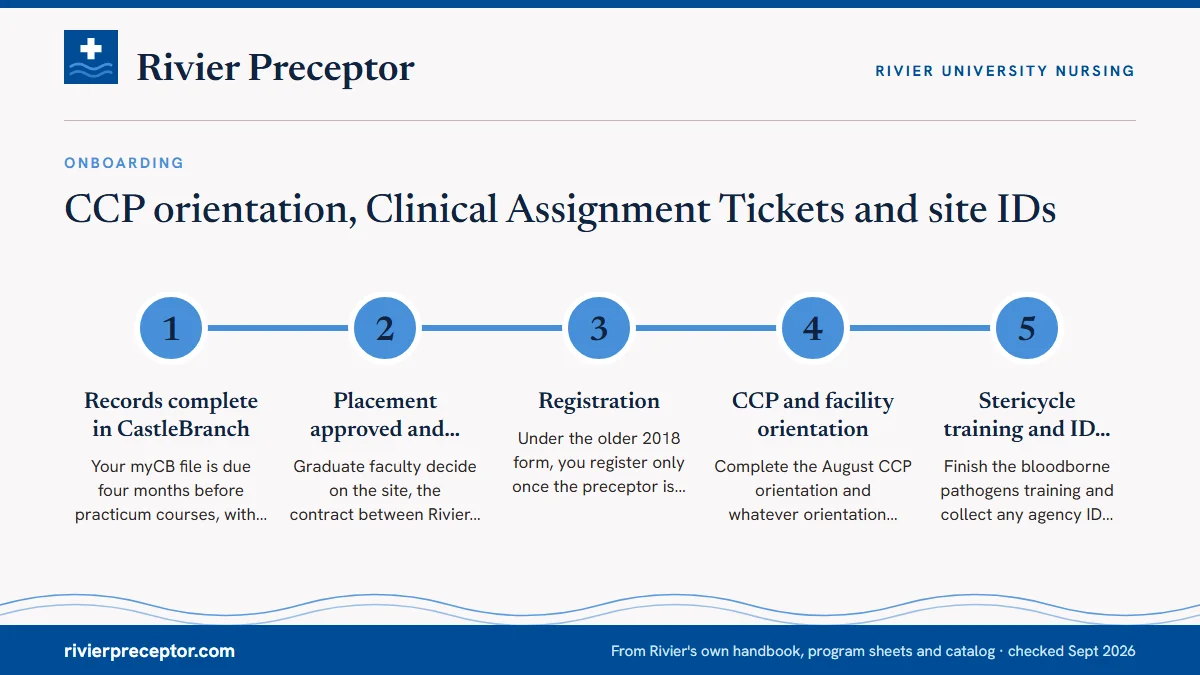
The order of events before hour one
From an approved preceptor to a first shift, the steps run in roughly this order. Some overlap; none can be skipped.
- Records complete in CastleBranchYour myCB file is due four months before practicum courses, with every requirement on record before the course starts.
- Placement approved and contract signedGraduate faculty decide on the site, the contract between Rivier and the site needs 30 days, and the Clinical Practicum Coordinator checks that every document and contract has arrived.
- RegistrationUnder the older 2018 form, you register only once the preceptor is approved and the affiliation agreement carries every signature; registering sooner can mean dropping the course later.
- CCP and facility orientationComplete the August CCP orientation and whatever orientation the site runs.
- Stericycle training and ID cardFinish the bloodborne pathogens training and collect any agency ID card.
- Print your Clinical Assignment TicketOne for this clinical experience, ready before your first day on site.
- Start on or after the first day of the semesterHour one falls on or after the semester's opening day as Rivier's academic calendar sets it.
The contract step has its own guide, affiliation agreements.
How we get you to your first shift
We plan your placement so onboarding has room to happen. When we confirm a site, we collect what it expects from students before day one: its orientation, its ID card process and any onboarding items beyond Rivier's list. You get that at the start, not in a last-week email, along with the practical details for day one: where to report and whom to ask for.
We stay with you through the start of the practicum. If a preceptor's schedule shifts or a site pulls out before your first day, we work on a replacement straight away, one that fits your track's rules and Rivier's approval process. Start with the form below, or see the steps we follow.
Questions Rivier students ask
Is Rivier's CCP orientation done online?
Yes. Rivier's Handbook describes the Centralized Clinical Placement orientation as an online orientation completed every August. It does not replace a facility's own orientation, which you also complete if your site requires one. Because it repeats yearly, students in their second or third practicum year complete it again each August.
What is a Clinical Assignment Ticket?
It is a document Rivier's Handbook asks you to print for each clinical experience. The rule is per experience, so a new site or a separate experience means another ticket. Your course faculty or the Clinical Practicum Coordinator can show you how to produce it and what it should include before your first day.
Do I have to pay for a hospital ID badge as a Rivier student?
If the agency charges for it, yes. Rivier's Handbook places agency ID card fees and replacement fees on the student. Not every site issues its own card, so ask at confirmation whether yours does, and look after the badge once you have it: a lost one means paying again.
Can I start clinical hours right after orientation if the semester hasn't begun?
No. The Handbook holds every practicum hour until the semester officially opens, no matter how early your orientation and paperwork are done. For 2026-27 the semesters open September 8, January 18 and May 10. The Clinical Practicum Coordinator must also have confirmed your documents and contracts.
Do online students outside Massachusetts complete the CCP orientation?
Rivier's Handbook lists the CCP orientation among clinical requirements without a separate rule for online or out-of-state students, so plan on it wherever your site is. If you are unsure which August cycle applies to you, confirm with the Clinical Practicum Coordinator well before your practicum semester.
Related pages
Last checked 2026-09-26
We check these pages against Rivier's own Nursing Student Handbook, program sheets, catalog, academic calendar and State Guide. Your program of study, your course faculty, your Program Director and the Clinical Practicum Coordinator have the final word.
Rivier asks you to identify a qualified preceptor. We make that the easy part.
Tell us your Rivier track, where you live and which semester your next practicum starts. We find preceptors who meet your track's rules, check early whether the site can contract with Rivier, and prepare everything the Preceptor Request Form asks for, well ahead of August 1 and December 1.
- Preceptors matched to the track: an MD, DO or FNP in outpatient family practice for
NURS 511, a psychiatrist or PMH-certified NP forNURS 521, a hospitalist or intensivist forNURS 638P - Preceptor license, credentials and CV ready for the Preceptor Request Form, with the site's contact details for the contract
- In your own area, in New Hampshire or any state Rivier's State Guide accepts
Start your placement plan
Track, city and semester is all we need to begin.